Executive Summary: This article discusses the four elements of positioning strategy that can apply to any brand: customer segmentation, frame of reference, differentiation, and reason to believe. These four elements answer the questions who, what, what is different, and why about any given product or brand. Regardless of what brand or product you are developing, answering these four questions will help you create a winning positioning strategy. Readers of this article, who might include anyone looking to learn fundamentals of business strategy including students, will learn about each of these four elements with concrete examples from the RxBar brand. By providing concrete examples as well as theory, this article aims to reach both concrete and conceptual thinkers.
Positioning Strategy Development Process
We’ve developed positioning strategies for a wide variety of B2B and B2C brands, typically in instances where the initial approach was not successful. One B2B assignment required bridging multiple B2B decision makers and multiple IT service categories. Another CPG positioning strategy example focused on the target customer as the hero, and the product as the humble helper (despite the brand’s technical superiority).
In both cases, the end goal of the positioning was for communications, branding and marketing. It was not meant to be the complete business strategy or value proposition. Regardless of the situation, we believe there are four critical elements to be integrated for a sound positioning strategy. Below, we’ll explain each element and then discuss how it relates to a brand we’ve covered before, RxBar.
Positioning Strategy Step 1: Who’s it For?
Which customer segment is the positioning developed for? There may be many customers, and customer segments, who purchase the brand, but it’s important as a first step to consider which segment(s) are the primary focus.
Pro tip: In our experience, during the development stage, it’s best to limit this to no more than two customer segments who share some (not all) common characteristics. That’s because it will be very difficult to develop a positioning if the segments have nothing in common. At all costs, avoid the watered-down approach of developing a positioning intended to appeal a little to all segments, which generally means it’s not compelling to any segment.
RxBar’s Example Positioning Strategy:
What Are the Customer Segments?
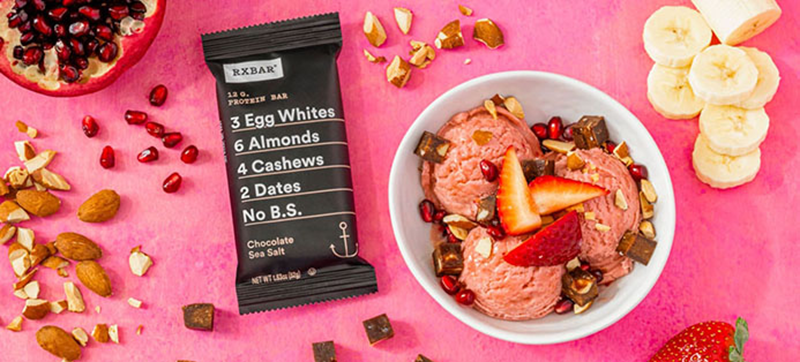
RxBar is a protein bar which heavily advertises its limited and “clean” ingredients, listing its small number of ingredients prominently on the front of the packaging. RxBar describes its customers on its website, claiming:
“our real food protein snacks are for the workout class aficionado. For the on-the-goer. For the parent who just wants a snack for their kid. With clean ingredients that are gluten free, high-quality protein, and little to no added sugar*, we try to make something for everyone to enjoy – no matter where they are on their wellness journey.”
The two distinct customer segments here would be:
- Health-conscious gym rats who are very focused on optimizing what they eat
- Parents who are concerned about what their children consume, perhaps because the children have dietary restrictions
These two groups are highly motivated to scrutinize ingredient labels, which fits nicely with RxBar’s emphasis on its short ingredient list.
Positioning Strategy Step 2: What’s the Frame of Reference?
How broad, or narrow, is the territory or category that your brand’s services and products address? What’s the relevant frame of reference for the customer? Who else competes within that frame of reference?
For instance, in financial services, the frame of reference could be as specific as a debit or credit card or broader to encompass managing day-to-day payments. Payments provide a good example, with Apple Pay, Venmo, Google Pay, Square, Alipay, bitcoin and many more.
Pro tip: Explore several frames of reference in the early stages to find the best fit for the customers and the brand’s situation.
RxBar’s Example Positioning Strategy:
How to Narrow the Frame of Reference?
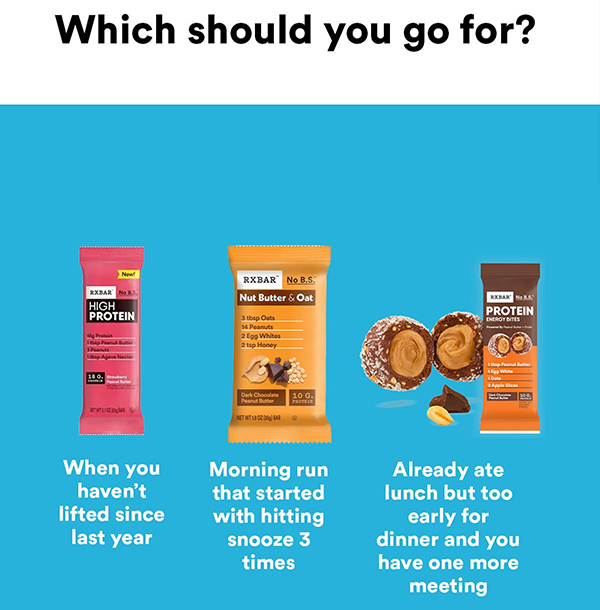
We can think of a few frames of reference for RxBar. The most obvious would be the protein bar space, but we can also think more broadly about high protein convenience foods, or even more broadly in terms of snacks and convenience foods. Understanding all these frames of reference helps us see everyone who might be interested in RxBar, from those who are specifically looking for a protein bar to snackers in general.
Positioning Strategy Step 3: What’s the Differentiation?
Specify how your brand’s benefits are differentiated from the competition. What are the emotional benefits in addition to rational benefits? Finding those points of differentiation can be the hardest part of the project. For some brands, the starting customer perception will provide some constraints and opportunities. Alternatively, other brands face an embarrassment of riches with many points of differentiation.
Pro Tip: Our recommended approach explores four to six benefit areas and multiple approaches within to cast a broad and deep net. The focus customer segments provide feedback to optimize and hone down to the most compelling solution.
RxBar’s Example Positioning Strategy:
What Sets this Brand Apart?
On the “What’s Inside” page of the RxBar website, we can see how the company talks about its products and how it wants to set them apart. Ingredients are described as “clean,” “real,” “minimally processed,” and “natural.” These descriptors seem to cluster into two benefit areas that set RxBar apart:
- The ingredients are relatively unprocessed and natural
- That the nutrient profile is “clean.”
Other benefits of RxBar include portability/shelf-stability, being gluten-free, sourcing in the US, and high protein content.
Positioning Strategy Step 4: What’s the Reason to Believe or Payoff?
The “reason to believe” is a product or service attribute that supports the brand’s differentiation.
Pro Tip: In developing positionings, an early step is to capture the reasons to believe to use in supporting the positioning. Often, the R&D team is the best resource for this information.
RxBar’s Example Positioning Strategy:
Clear Differentiation Right on the Packaging
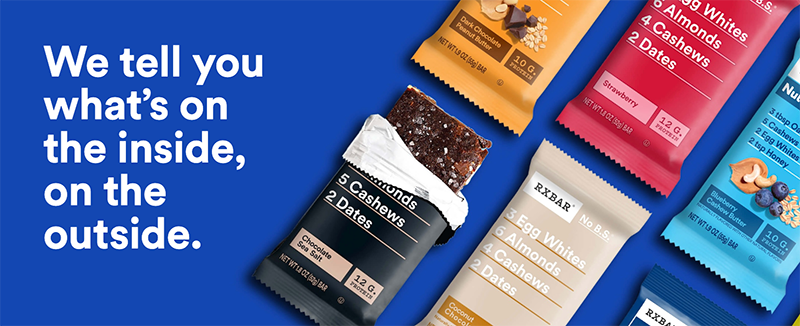
RxBar has a strong reason to believe, listed right on the front of the package. Because of their focus on simple ingredients that are likely already familiar to consumers (such as egg whites, dates, and nuts), RxBar can display the evidence of their claims to differentiation in terms that anyone can understand, without having to describe any technical complexity of the product.
Example Positioning Strategy Statement Framework
The classical framework for a positioning strategy looks something like this:
- To target [specific audience],
- For [defined] frame of reference,
- Brand X is the [functional/emotional] point of differentiation
- Because [attributes] reasons to believe
Pro Tip: Positioning strategy is an iterative process, so it’s helpful to draft an early positioning statement(s) using the framework, and then keep modifying it as you optimize with customers.
From B2B to B2C, from Fortune 500 companies to sole proprietorships, effective positioning strategy drives communication, branding and marketing to deliver impressive results.
RxBar’s Example Positioning Strategy:
Putting it All Together
After our analysis above, we can write an example positioning strategy for RxBar:
RxBar targets gym rats and busy parents who are looking for a protein bar or snack. RxBar is the best option for a minimally-processed protein bar, because it uses simple ingredients like egg whites, nuts, and dates.
From B2B to B2C, from Fortune 500 companies to sole proprietorships, effective positioning strategy drives communication, branding and marketing to deliver impressive results. Insight to Action’s resources page has more information on all these topics. You can also contact us to speak with a member of our team about these topics, or subscribe to our newsletter.