


Executive Summary: Developing a growth strategy using an agreed-upon template is a major decision that requires organization-wide commitment, especially from leadership. This article covers increasing search interest in growth strategy, along with the business volatility that has only increased since COVID. There are six compelling reasons for when it’s time to invest in growth strategy, and several reasons for when to avoid it.
When to Work on Growth Strategy… And When Not To
Why are you thinking of investing the time and energy to develop a growth strategy for your organization? What is the purpose behind following a disciplined growth strategy template?
There are many online resources that suggest how to complete a growth strategy template, including a step-by-step guide, a complete strategy map template and related videos. Before jumping into this activity, we’d suggest taking a step back to inquire why a growth strategy will be useful for your organization.
It may be that your organization is “too busy” to benefit from using a growth strategy template, and instead needs to focus on the current markets and current customers with the base, legacy business.
If your purpose in completing the growth strategy template is just to make a pretty presentation, I’d suggest saving yourself the time and energy.

Completing a Growth Strategy Template Isn’t for Leaders Who Are Solely Focused on Maximizing the Legacy Business
With the major demand shifts in 2020 caused by COVID closures, most CPG (consumer packaged goods) companies in the paper, cleaning, and food and beverage categories focused on delivering their most popular existing products to their existing customers. While there may have been interest, there simply weren’t resources to focus on innovation and new products in other categories, or on new customers.
Those shifts also significantly increased demand for eCommerce, telemedicine and remote work. Products and services like Zoom and Instacart grew by riding the wave of this shift in demand. Work processes changed quickly, and whether a growth strategy or not, investments have been made in new approaches, and remote selling has become common.
After years of reliance on in-person meetings at industry conferences and trade shows for new business, sales teams and their customers needed to adapt to remote selling and meetings via Zoom. In the words of one executive we know:
“I’ve attended Natural Products Expo West in person for years and found it helpful for trends, new product ideas and making valuable connections. For me, it’s been a struggle to get value from attending virtually .”
In another case we are aware of, a company needed to invest over $100,000 in Zoom, despite having duplicative capability in another video conferencing (Microsoft Teams)—all because Zoom met their customers’ requirements for ease of use.
Even outside of COVID impact, in the past 10 years, I’ve regularly spoken with business leaders who are caught up “in the business.” They are overwhelmed with the many seemingly-essential activities they are personally involved in each day. They can’t imagine taking time to work “on the business” to develop a long-term growth strategy. This unsustainable approach to micro-managing their organization drives away talent and often comes at the cost of the leader’s health and relationships.
Is Growth Strategy Trending in 2025 and 2026?
Looking at Google Trends on the search term “growth strategy template” reveals almost no activity in 2022, 2023 and 2024. From April 2025 to April 2026, searches for “growth strategy template” increased considerably (see chart).
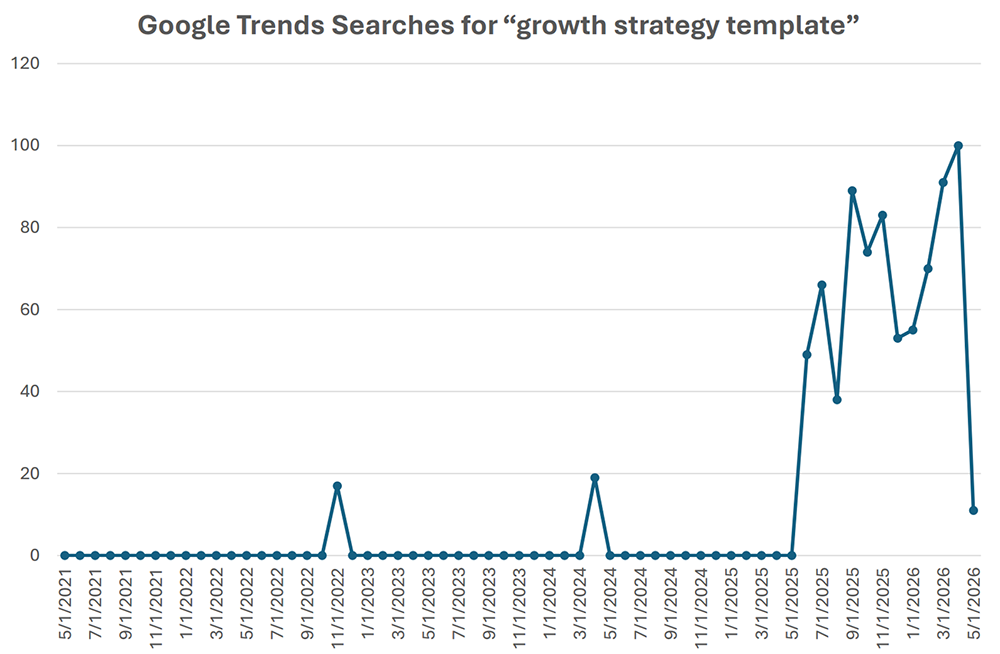
This interest may indicate greater leadership focus on growth strategy. However, the most recent month shows a lower result. While Google Trends data has been flagged by one source as inconsistent, nonetheless the information may indicate greater recent interest in 2025 and 2026.
What’s Causing Business Volatility in 2026?
Leaders we work with also perceive greater business volatility, starting with COVID. We’ve already discussed the fundamental demand shifts in certain industries from COVID. For example, as many companies downsize or eliminate the offices that workers previously came into each day, commercial real estate has suffered, even to the extent of foreclosure. Business meetings are more often virtual. Even if conferences and events are coming back, everyday meetings in person are less common. These are COVID impacts, and the resulting shift in work structure.
The rolling wave of tariffs that started in February 2025 forced businesses to reevaluate their supply chain and manufacturing strategies. We had several growth strategy insights studies that were canceled in March 2026 as leaders focused on tariff impacts and mitigation.
Another impact is the oil price increases starting in March 2026. This followed the February 26, 2026 start of hostilities with Iran. In our Vistage groups, members encourage each other to build in freight increases to offset these impacts.
To be sure, there is an opportunity to pivot and be agile, but it’s also difficult to anticipate the future direction of demand in many businesses.

Situations Where a Growth Strategy Template May Merit the Leader’s Resource Investment
We’ve heard from several CPG leaders who are looking to develop a refreshed three-to-five year growth strategy in 2025 and 2026.
There are several situations where building a strong growth strategy makes sense for these leaders. These include the following:
- Accelerating eCommerce business for growth (often in situations where eCommerce is underdeveloped).
- Identifying growth initiatives that justify an investor or buyer spending more money on the firm.
- Building a sustainable leadership team and business model that does not require the founder’s involvement in the business day-to-day.
- Expanding the existing business geographically into new markets. A common strategy is a geographic rollup of a number of smaller firms in the same business in an unconsolidated industry. The rollup can provide a more profitable business model with efficiency in areas such as purchasing, accounting, recruiting, and marketing.
- Expanding offerings for existing customers. This growth strategy will often require new capabilities to deliver new categories. Again, acquisition may be the approach that some find most expedient to develop these capabilities, rather than developing in-house.
- Expanding into all-new markets with new customers. This is the riskiest strategy, and taking the time to complete a growth strategy template, review it, and pressure test it is definitely indicated.
Getting to the Point: Growth Strategy Template
To help others understand your vision, such as investors, employees, or stakeholders, boil it down to a prioritized and focused growth strategy.
A recent story vividly illustrates this principle:
“Our firm has three distinct software products that appeal to three different types of buyers, including systems integrators and super-scaler cloud providers, among others. We had a four-hour meeting with the CTO (Chief Technology Officer) of one of the world’s largest technology firms and reviewed each of our product lines. At the end of the four hours, instead of moving forward with our products, he asked us to give him more time for the team to get their heads around the information. That’s when we realized we have to focus on one product line only with a customer. It was a valuable lesson.”
“We are now suggesting that the customer just buy one product. That’s working well. Another example of this is Turbonomic, one of our competitors that sells only one product. They are being purchased by IBM for $1.5B.”
Disruptive technology CEO in Southern California
Getting to the point may seem oppositional to identifying all the possible growth strategies that your organization can pursue. Your organization will likely have more than one product or service offering, and more than one market segment, and be able to grow in several areas.
In the end, however, there are only so many resources and so much time, and prioritization is required.
The question is, if you had to get to the point, what is the #1 growth strategy for your organization that is relevant to the audience you are engaging with? For instance, is it eCommerce? Is it geographic expansion?
After engaging with the top growth strategy, you may find that stakeholders are sufficiently interested to explore the additional growth strategies, products, services and markets that your organization can address.
Considering insights and outside perspective from the market and customers will help with prioritization, as will focused discussion by the leadership team.
If you answer “yes” to all of these questions, your organization may be ready to follow a growth strategy template. Do we have the desire for disciplined growth? Will we act on our plan, even when day-to-day situations arise? Can we motivate the organization to stay the course?
For more resources on growth strategy, please visit our resource page or contact us.
