


Executive Summary: This organic food customer segmentation example investigates the U.S. organic food market. The market is large and growing, reaching about $70 billion in 2025, with growth outpacing food overall and particularly strong gains in categories such as meat, dairy, berries, and baby food. Organic purchasing is most strongly associated with parents of younger children, younger adults—especially Millennials—and higher-income households, although some parents prioritize organic despite more limited disposable income. Regenerative Organic Certified products appear to be extending these same motivations, particularly among parents of children under 12 and childless Millennials with greater disposable income. For food brands, these broad demographic segments provide a useful starting point, but effective segmentation will require deeper understanding of category-specific motivations, need states, and whether the relevant decision-maker is the individual or the household.
Which Product Categories are Driving Growth in the $70 Billion Organic Food Market?
With between 45% to 83% of US households buying organic and $77B in certified organic 2025 US sales, an organic food customer segmentation example is well worth exploring.. Within certified organic, organic foods at $70B are the largest part, growing at 6.9% year-over-year. That’s more than double the rate of food overall.
According to the Organic Trade Association (OTA), organic produce (fruits and vegetables) is the largest portion of the organic foods market, at $23 billion or nearly 30% share, followed by organic grocery at $16 billion or approximately 21% share. The remaining organic categories are beverages (13% share), dairy and eggs (13% share), snacks and candy (7% share), frozen (4% share), meat poultry and seafood (4% share) and other which includes supplements, pet food, textiles and HBC at 9% share. See the chart below.
| Organic Foods Product Category | Annual Sales | Organic Foods Market Share |
| Produce (fruits and vegetables) | $23B | 30% |
| Grocery | $16B | 21% |
| Beverages | $10B | 13% |
| Dairy and eggs | $10B | 13% |
| Snacks and candy | $5B | 7% |
| Frozen | $3B | 4% |
| Meat, poultry and seafood | $3B | 4% |
| Other (supplements, pet food, textiles and HBC) | $7B | 9% |
Fast-growing, consumer-reported organic food categories include:
- Baby food and formula: +8.8%
- Milk and cream: +9.3%
- Berries: +10.5%
- Dried beans, fruits & vegetables: +13.6%
- Meat, poultry & seafood: +22.5%
While this growth is impressive, it’s also true that organic foods carry a price premium over their conventional counterparts. It may be the case that higher dollar growth in organic foods in the past year reflects bigger price increases on organic compared to price increases in conventional. For instance, organic produce typically carries a 50-80% price premium over conventional, a fact that I note each time I grocery shop for fresh strawberries, raspberries or blackberries.
Organic Food Customer Segmentation Example:
Where Are Consumers Shopping?
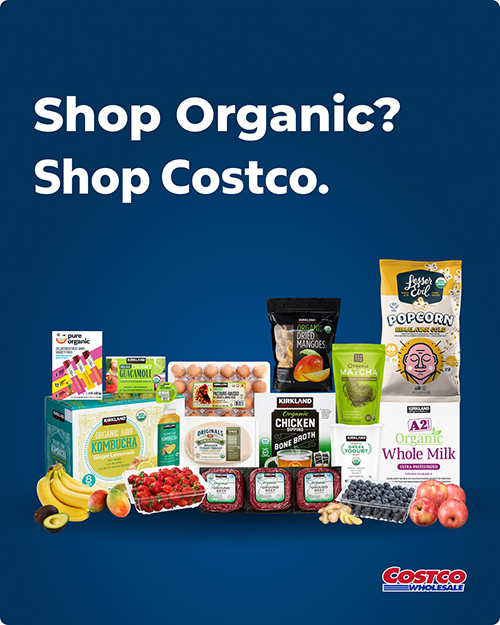
Retailer Costco is recognized by OTA as the largest US retailer of organic products, so it’s a key player in an organic food customer segmentation example. In fiscal 2021, Costco reported $6.3 billion of sales in organic food and $2.3 billion in organic produce. It’s well known among food manufacturers that Costco prefers and even requires organic choices. Online, some 20% of its Kirkland brand grocery products are organic, supporting the value Costco brings. In fact, Costco touted the value it offers on organic:
“For example, as compared to conventional supermarket organic prices, Costco offers an approximately 30-40% value on avocados, a 33% value on organic bananas and asparagus, a 33-35% value on chicken, and a 25% value on ground beef.”
Organic Food Customer Segmentation Example:
Who are the Consumers?
Let’s explore five main categories for our organic food customer segmentation example. Looking at multiple sources, there are three demographically defined segments, one motivational segment and one retailer segment, as follows:
- Demographic Segment: Parents of younger children (under age 12, with special focus under age 6)
- Demographic Segment: Childless younger adults ages 18-27 and 28-43
- Demographic Segment: Higher income households, $75,000+
- Motivational Segment: “True Believers” from New Hope Network who are typically ages 25-54
- Retailer Segment: Costco purchasers

Organic Food Customer Segmentation Example: Parents
It makes sense to find baby food on the fastest-growing organic category list, as parents are more likely to buy organic for infants and toddlers under two, followed by children ages 3-5, then children ages 6-12, and lastly teens 13-17. Teri Lucie Thompson and I found that parents are most likely to prioritize buying organic when their children are in younger age categories.
Overall, 41% of moms claim to be looking for organic on food labels when purchasing for their children, compared with 43% of dads. And, Ingredient scanning app Yuka awards 10% of its score to products that carry “an official national or international organic label,” so this organic factor is a small component of Yuka’s overall score.
Organic Food Customer Segmentation Example: Higher-Income
An older Gallup study found that $75,000+ household income households were more likely to actively try to include organic. It’s not surprising that the higher-income households are more likely to purchase organic, though the recent SPINS work highlights the fact that parents may prioritize organic even if they are not higher income.
Organic Food Customer Segmentation Example: True Believers
With its three-pillar basis of soil health, animal welfare, and social fairness, Regenerative Organic Certified (ROC) is a next level in organic that is growing in popularity. According to SPINS, ROC saw a 22% increase in consumers in 2025. And SPINS describes the customer segments who are most likely to buy ROC food products as falling into the “True Believers,” with demographic skews to two segments:
- Parents of children under the age of 12 who may not have disposable income but who prioritize their children’s nutrition
- Millennials with no children who have more disposable income
Organic Food Customer Segmentation Example: Boomers to Millennials to Gen Z
While more recent studies don’t find evidence of an older, 55+ consumer who prioritizes organic, historically there was an older “Enlightened Environmentalists” segment who also favored organic.
Instead, recent sources find adults ages 18-27 and 28-43 are most likely to focus on organic foods.
A recent Hartman study looked at a long list of claims and other attributes asking:
“Which of these are MOST IMPORTANT to you when selecting food and beverage products to purchase?”
Organic was ‘most important’ to 13% of adults ages 18-70, with an over index of 120+ among Millennials.
As may be expected, taste (63%), price (60%) and fresh (42%) topped the list overall. There are many other claims that performed similarly or well ahead of organic including (among others):
- High in protein (28%)
- Convenience / ease of use (26%)
- Natural (22%)
- Simple ingredients (21%)
- No/low sugar (21%)
- High in fiber (18%)
- No GMOs (14%)
- Low fat / fat free (13%)
- Organic (13%)
- Gut-healthy (11%)
In this recent study, the younger cohort of Gen Z only over-indexed on low-calorie, while Boomers over-indexed on many claims, including fresh, low/no sugar, less processed, heart health and low fat/fat free.
Several studies have also found that consumers do have some confusion and skepticism around organic claims, whereas a claim such as no/low sugar is more straightforward to validate with on-package labeling. For example, 62% see the USDA Organic certification as weaker now than it used to be (18% agree completely).
Organic Food Customer Segmentation Example:
What Does the Data Mean for the $70B Organic Food Market?
Broad organic food customer segmentation examples like “True Believers,” Millennials and $75,000+ households are a starting point for the food brand to use and are supported by multiple studies.
However, they lack insight into the motivations specific to the food category and the relevant need states.
Diving deeper, the brand will need to understand the food category of interest and its role in the consumer’s diet and lifestyle. And depending on the category, it may be more appropriate to look at an individual segmentation or a household segmentation.
Insight to Action is the west coast’s premier market research and business growth consulting firm. For more examples on customer segmentation, visit our resources page. To start a conversation with our experts, contact us.
