Executive Summary: This article uses the beer industry as a market segmentation example. We segment the market into value, standard, premium, and super-premium beers to explain why some brands have grown despite declines across the broader North American beer market. The analysis shows that premium and especially super-premium beers have steadily gained market share while value beers have declined, perhaps explaining why dollar sales have fallen less than sales volume. We also discuss how changing consumer definitions of value (emphasizing quality, experience, and health rather than simply low prices) fit into broader food and beverage trends, and how growth in super-premium beers compares to growth of BFY sodas. Finally, we show how market segmentation transforms broad market statistics into actionable business strategy by identifying the segments with the greatest opportunities for growth.
Why Some Beer Brands Are Seeing Success in a Declining Market
Currently in Boston, demand outpaces supply for beer. Last week, when my husband was trying to buy a beer at a restaurant, he had to change his order twice because so many brands were sold out. This localized beer shortage is an effect of the ongoing World Cup. The Scots came to our city, and they were wonderful guests and a pleasure to see in their kilts. But they drank us dry!
The overall picture is sadly a little different. In 2025, the market for beer in North America was estimated at $190 billion. However, as the table below from Beverage Industry shows, many major beer brand families are facing declines in sales measured in both cases and dollars.
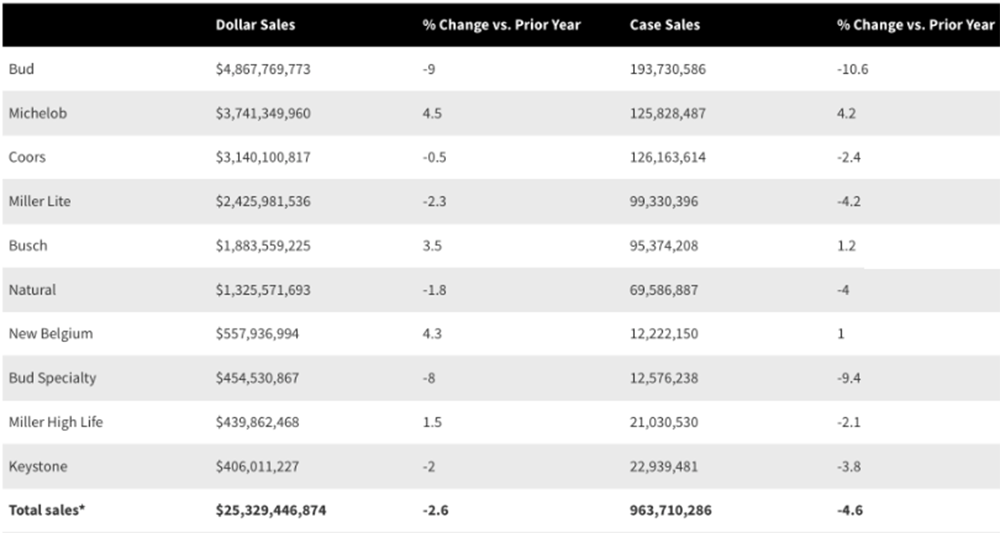
There has been an overall 5% decline in volume leading into 2025 and a 3% decrease in dollar sales. The gap between these two numbers is interesting – why might there be a 5% decrease in sales volume but only a 3% decrease in dollar sales?
Plus, some brands did not face declines in dollar sales or volume. Michelob, Busch, and New Belgium all increased sales in terms of both dollars and volume. Let’s explore this market segmentation example.
Market Segmentation Example:
How Should We Categorize Beer Brands?
One lens that can help us to make sense of this market trend is market segmentation.
While we can segment the beer market in many ways, like type (Lager, Stout, Ale, Porter, Sour, etc.), regional origin, etc., today we’ll use value/price categories. We can segment the market into four categories. I’ll give examples of how much a given brand in a particular category costs on Instacart near me in Boston, MA.
- Value: These are the lowest-price category of beers, focusing on affordability. I can get a 12-pack of 12-ounce cans of Natural Light beer for $12.69, or about $0.09/ounce.
- Standard: This category is a step above value but still affordable. Budweiser’s American Lager might be an example: I can buy a 12-pack of 12-ounce beer for $14.49 on Instacart right now, or about $0.10/ounce.
- Premium: Premium beers market themselves as celebratory or indulgent, perhaps highlighting craft in brewing. A 12-pack of 11.2-ounce bottles of Stella Artois will run me $21.29, for about $0.16/ounce.
- Super-Premium: Michelob Ultra is often considered an example of a super-premium beer, although on Instacart right now I can actually get it for less than Stella, at $16.99 for a 12-pack of 12-ounce beers, or $0.12/ounce. This speaks to the fact that while these segmentations are meaningful, the exact borders between categories that describe a continuous variable like price must be to a certain extent positive rather than natural.
A Market Segmentation Example Reveals a Path Forward for Beer Brands
As we can see in this graph below from IWSR, Value beers slowly lost market share from 2019-2024. Standard beers had a small increase from 38-40% volume share, as well as Premium beers. A big winner were super-premium beers, which went from 8% of sales volume to 11%, a rapid increase proportional to the initial size of the category. Looking at sales by volume, as we do below, also underreports the share of super premium beers compared to looking at sales by dollar amount (as each super-premium beer sold definitionally contributes a higher dollar amount to the sales total).
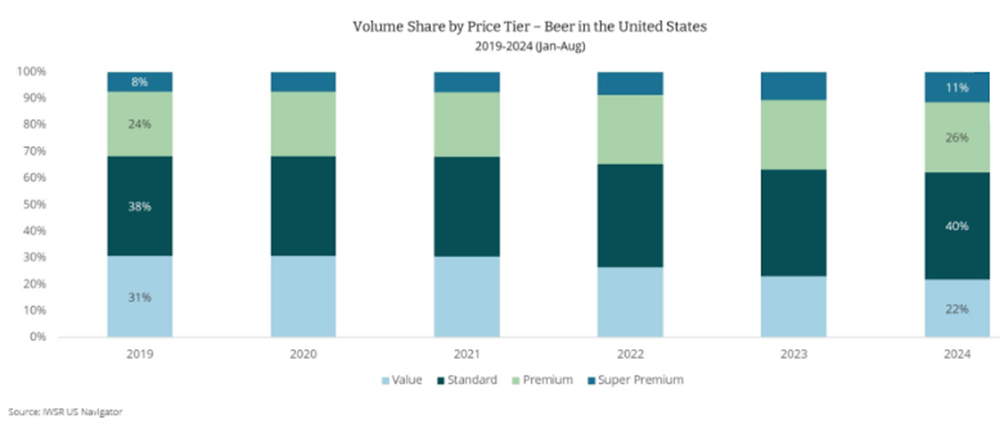
This data also might explain the question I posed earlier, why there was an overall 5% decrease in volume but only a 3% decrease in dollar sales. If the most expensive beers became a higher percentage of the sales volume, you would expect the dollar sales to suffer less than if the distribution by category stayed the same. Another possible explanation for the gap would be increasing prices across the two time points, which could also account for the same gap.
Market Segmentation Example:
A New Meaning of Value Among Beer Drinkers
According to CNBC, the differences in market segments hold true for Annheiser-Busch:
“Michelob Ultra remains resilient with volumes relatively flat, while Bud Light and Budweiser continue to post double-digit volume declines.”
While you might think that higher-priced products would perform more poorly in times of economic struggle, Convenience.org reports:
“Value is increasingly important to shoppers, but in the beer context, value doesn’t just mean low prices. It means a high-quality product in a convenient format and location at the right price.”
This focus on value, and what value means to today’s consumers, is best understood in terms of the largest trends shaping the food and beverage industry today. And it’s an important element of this beer market segmentation example. We have recently reported on a number of health trends in food and beverage, including demand for protein, the changes wrought by GLP-1 drugs, and finally the rise of healthier sodas like Poppi and Olipop.
Generally, it is clear that consumers are demanding more from their food and beverage, and they are willing to spend more in some cases to get it. A low-cost beer might simply not be delicious enough to outweigh its poor health benefits.
What Do Beer and Soda Have in Common?
The rise of Poppi and Olipop is perhaps most comparable to the rise of super-premium beer. These sodas are pretty expensive compared to something like Coke or Sprite, and yet they are doing well in a declining category, just like the super-premium beers. The disanalogy of course is that BFY sodas offer health benefits, whereas super-premium beers are competing on taste and status.
Perhaps as customers try to minimize the amount of alcohol they consume overall, they expect each beer to be a more pleasurable experience, meaning they are willing to pay more. In this way, they are still optimizing for health by consuming less of a more premium product. It is striking that in both of these beverage categories, which are everyday indulgences, the overall market is stagnant but certain premium options are doing well.
Market Segmentation Example:
How to Analyze the Numbers to Understand Your Customers
How would this overall trend affect the recommended market strategy for a business? Imagine yourself in this market segmentation example. You need to make decisions about how to increase or maintain profitability at a beer business, and you notice a decline in sales volume and dollar sales of 5% and 3% respectively, reflecting the overall market trends.
These overall numbers would be great for detecting a problem, but they would not tell you what to do about it. Splitting up the different beers your company sells into categories would help you to see that super-premium beers were actually growing in sales volume, despite declines in other parts of the business. A market strategy that focused on selling super-premium beer would probably yield better results than one that simply tried to increase sales across the board. Market segmentation helps your business to better understand the market and target your interventions.
Insight to Action can help you segment the markets you are in and the customers you are reaching, so that you can target growth areas as opposed to wasting your efforts. To learn more about market segmentation and related topics, check out our resources page for more articles, or subscribe to our newsletter, your go-to source for the ever-evolving world of market strategy. If you think your business could benefit from our expertise, contact us!