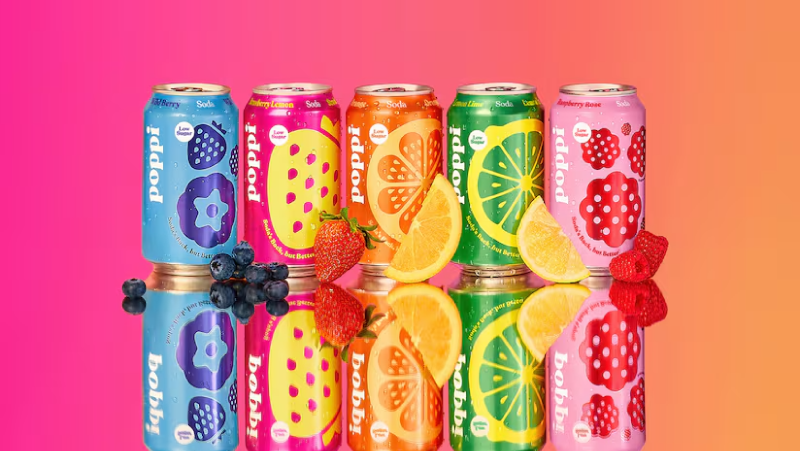
Executive Summary: This article explores the positioning strategy example of Poppi, a better-for-you soda, and argues that the soda succeeds in part because it positions itself as both new and old. Poppi’s positioning is contrasted with that of both traditional soda and its closest competitors. In the soda market at large, its health benefits are a differentiator. But in the better-for-you market (BFY), Poppi is more differentiated by its appeal to Gen Z. The article is intended for audiences interested in food and beverage trends, the impact of GLP-1 medications, marketing to Gen-Z vs. other audiences, and all who are interested in positioning strategy, providing an analysis of positioning strategy and how it interacts with a number of these topics.
Gen-Z, Charli XCX & Fiber-Forward Soda: A Neon Mix of Guilt-Free Beverages
I like to cruise Whole Foods for my next weird food experience or unneeded all-natural skincare purchase, and while I’m there, sometimes I am even generous enough to look out for a treat for my root-beer-loving husband. I was therefore intrigued when I spotted Poppi, a brand offering a root beer with only five grams of sugar (and three grams of fiber to boot). My husband’s ultimate review wasn’t glowing – I believe he used the phrase “ok, actually,” and indicated that he preferred our favorite sparkling water (Waterloo Guava Berry) – but the experience got me thinking about Poppi as a positioning strategy example.
I’ve seen Poppi, a brand which sells all kinds of low-sugar sodas, more and more over the last few years. Indeed, the brand is growing: Poppi was acquired by PepsiCo about a year ago for the substantial sum of $1.95 billion, only seven years after its founders appeared on Shark Tank in 2018. And Insight to Action has featured Poppi as part of Sam’s Club’s BFY brand strategy examples.
What gives? What can we learn from Poppi? Today, we’ll discuss Poppi’s positioning strategy.
- We’ll dive into the difficult situation for the market
- Discuss how Poppi positions itself with respect to soda
- Compare its positioning to its closer competitors like OliPop and Culture Pop
Poppi succeeds by positioning itself as both new and old, and appealing to a demographic that its closest competitors are not targeting.
Positioning Strategy Example:
How Beverages Are Impacted by GLP-1s
The soda industry is facing some challenges. Consumers are less interested in traditional soft drink offerings and more interested in options with some health benefits. One key driver is the rise in adoption of GLP-1s. We’ve covered the impact of GLP-1s before.
For many categories, GLP-1s present a threat, and soda is no exception. The table below, sourced from AlixPartners and Numerator, shows how beverage purchasing behavior changes on GLP-1 drugs. As we can see, while all beverage consumption decreases for GLP-1 consumers, soft drinks are the most impacted, with a 7% decrease in consumption.
| Table 1: Impact of GLP-1 on Beverage Consumption | |
| Category | Average Annualized Impact (%) |
| Soft Drinks | -7.0% |
| Coffee & Energy Drinks | -4.0% |
| Juices | -4.0% |
| Alcohol | -1.4% |
| Water | -0.5% |
| Source: Cornell, Numerator. Data are for six months after taking the medication | |
Our friends at Numerator also supplied us with this paper, which indicates that GLP–1 users had a 5% decrease in soda consumption over the first six months (wondering what GLP-1 users do eat? Yogurt purchases were up about 3%, as Insight to Action wrote about in “Protein Drink Brand Strategy Examples: Chobani and Oikos”).
Poppi as a Positioning Strategy Example
In order to meet these changing needs, Poppi positions itself:
- As a low sugar, healthier option
- As both youthful and nostalgic
- As both new and classic
How Does Poppi’s Packaging Support the Brand’s Positioning?
To understand Poppi as a positioning strategy example, let’s take a look at how Poppi presents itself, starting at a very basic level with the cans of soda they sell. As you can see below, even on the cans, Poppi shows itself as both new and classic. The tagline “Soda’s Back, but Better” positions Poppi both as a return to a classic (which is “back”), and as a new option (something “better”). This ties into the blend of novelty/youthfulness, with nostalgia that is typical of their packaging and advertisements.
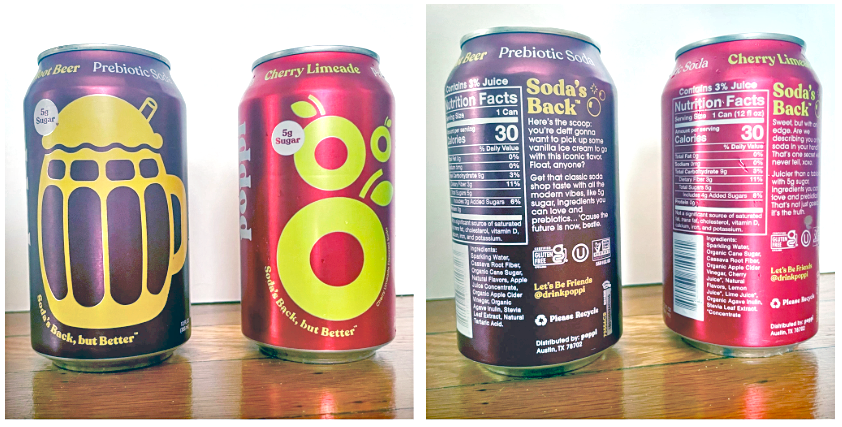
The image on the Root Beer can is a simplified and stylized image of the classic root beer mug. It depicts something traditional using a more contemporary style. The back of the root beer can touts a “classic taste” and “modern vibes,” again using the same blend.
The Cherry Limade, on the other hand, seems to lean more into health, with organic shapes and leaves on the front, which suggest some kind of plant nutrition. Both cans prominently display the low sugar content of the soda (although neither lists the fiber content on the front of the can – probably a smart move, given that fiber beverages might make one think of metamucil).
What Do Poppi’s Advertisements Communicate?
We can see many of the same themes in Poppi’s 2025 Super Bowl Commercial, Soda Thoughts. The ad depicts young people who want and are craving a soda, but are worried about the sugar content. Then, they see Poppi as an option, and their issues are solved. Poppi is depicted as a better alternative to soda, its low sugar content highlighted once again.
All of the people in the Superbowl 2025 ad are quite young, but the settings are somewhat retro – an old-school diner, a drive-through. The clothing, objects, and cars in the ad have color schemes that match the Poppi cans. The message seems to be that Poppi is a new solution that fits into the retro world of these young people perfectly, and solves any issues they might have with soda.
The Super Bowl 2026 Commercial is perhaps even more clearly aimed at Gen Z. The spot is set in a dimly-lit college classroom, the lecturer putting one in mind of Ben Stein in Ferris Bueller’s Day Off. One student opens up her can of Poppi, and the boring lecturer is replaced by Charli XCX, a star famous for her hyperpop music. Another popstar (Rachel Sennot) also appears in the rows of seats, and Charli explains to Sennot that they are there because of “vibes.” The college class gives way to a neon-lit rave for a moment, before we snap back to the regular lecture. The original student takes a sip of her Poppi, and the boy next to her asks if he can have one.
This ad is typical of Poppi’s partnerships with popstars – Poppi has been associated with Hailey Bieber, Kylie Jenner, Billie Eilish, Russell Westbrook, Jennifer Lopez, and Olivia Munn, according to PR newswire.
Setting the ad in a college classroom seems to appeal to the high school and college demographic, and the language used is that of Gen Z (although to my Zillenial brain, the language seems to be characteristic of the older half of Gen Z), and the jokes and plot of the ad are in-line with Gen Z’s proclivity for absurdism. This ad strongly positions Poppi as trendy and hip.
Poppi also produces more videos that highlight its low sugar content – for example this short showing a young woman brandishing a sandwich bag full of sugar – apparently the amount of sugar you would consume weekly if you had a can of typical soda per day.
Positioning Strategy Example:
Comparing Poppi, OliPop and Culture Pop
How does the positioning of Poppi compare to its closest competitors, like OliPop and Culture Pop? When Poppi is positioning itself against standard sodas (which is the bulk of its positioning), health benefits are key. But with its closest competitors, Poppi must seek other differentiators.
The supposed health benefits of each soda are similar. While Poppi is unique in its inclusion of apple-cider vinegar, it more heavily emphasizes its low sugar content and prebiotics, which are shared with OliPop and mostly shared with Culture Pop (the latter has probiotics instead, but all make claims to improve gut health). When we look at flavors, Poppi’s nostalgic elements are shared with OliPop, which has flavors like “Classic Grape.” Culture Pop, by contrast, seems to be aiming to project a more sophisticated and offbeat image with flavors like “Lemon Lime and Cardamom” and “Strawberry Rhubarb.”
In terms of age demographic, OliPop seems to be aimed more squarely at Millennials and older, with multiple cans in millennial pink and multiple ads themed around adult women 30+ enjoying Olipop as they think back to their own childhoods. Culture Pop also seems to be aimed more at adults : their partnership with Noah Kahan feels like a throwback to the music of the 2010s, though Kahan is popular in 2026. Like OliPop, Culture Pop includes actual children in their advertisements, along with adults old enough to be parents.
Comparatively, Poppi ads feature adults below the average age of childbearing in the US and no actual children in sight. Poppi focuses on what we might call the “emerging adult” demographic of college-age adultolescents.
If we had to sum it all up, matching each soda to a recent cultural touchpoint, Poppi is the Barbie movie, Olipop is Sweetgreen, and Culture Pop is Noah Kahan (good pick on their part).
| Brand | BFY Edge | Other Positioning Elements | |
| Poppi | Prebiotics, low sugar, apple cider vinegar, fiber | Nostalgia, Gen Z humor and brand partnerships, classic flavors, blend of new and old | |
| OliPop | Prebiotics, low sugar, fiber, botanical extracts | Nostalgia, classic flavors, Millennial pastel cans, ads aimed at adults | |
| Culture Pop | Organic, probiotics, no added sugar or artificial sugar (but includes sugar from organic juice) | Offbeat flavors and slightly hipster vibe, tagline “If Soda Grew on Trees” suggests natural and crunchy | |
When we compare it to its closest competitors, Poppi is the positioning strategy example most clearly presented as youthful and appropriate for the 18-25 crowd. When compared to traditional sodas, the BFY positioning is important. However, in the space of BFY, Poppi’s health benefits are less of a differentiator compared to its branding and partnerships.
Positioning Strategy Example:
Poppi Insists Fiber’s Not for Fogies
Poppi’s positioning strategy solves two problems.
- First, soda is less and less appealing in an increasingly health-conscious market, especially with the impact of GLP-1s.
- Second, a BFY option still needs some way to appear aspirational and desirable. If people want a pure fiber drink, they can buy metamucil, so these BFY sodas need a way to still appear fun and indulgent.
Poppi addresses these challenges by positioning itself as both new and old, nostalgic and very youthful. That way, it can claim all the fun and indulgence of traditional sodas while also claiming to be innovative and better for you. Against its closest competitors, Poppi sets itself apart by appealing to the adultolescent demographic, more Gen Z than Millennial.
To stay on top of market trends, subscribe to the Insight to Action newsletter. And contact us to discuss all your market strategy needs.