


Executive Summary: This article argues that Helldivers 2, a live service video game, suffers from a costly but common challenge: ambiguous positioning strategy marketing that fails to define the game’s unique vision. Reliance on “thin” marketing terms like “fun” and “balance” makes Helldivers 2’s updates feel arbitrary, undermining player trust and long term engagement. By adopting “thick” positioning — precise, concrete language that explains what the game is and who it is for — Helldivers 2 could rebuild goodwill and recapture significant lost revenue.
Helldivers 2 Is a Massive Commercial Success
The strengths and weaknesses of Helldivers 2’s positioning strategy marketing arguably explain much of its initially shocking success, rapid decline, and shifting financial fortunes.
Helldivers 2’s Level of Sales Surprised Everyone
It is hard to overstate how unexpected the success of Helldivers 2 was, even to its creators. Helldivers 2 (2024) was so popular on its release it became unplayable for most; the servers could not handle the stampede of delighted players. Success trampled the doorframe on its way in. The developers of Helldivers 2, Arrowhead, scrambled to manage the situation.
Things got so bad after launch, then CEO of Arrowhead Johan Pilestedt tweeted:
“If you have no cash, get the game later. While we made a really fun game, it’s worth waiting until the servers can support capacity. I mean, as CEO, I would, of course, want the game to be as profitable as possible, but if you spent your last dollars and got stuck in server queues I’d be heartbroken.“
The idea that a CEO would encourage consumers, not to purchase their product, to better satisfy them proved viral and brought more attention, effectively acting as free marketing. Helldivers 2’s publisher wasn’t happy about Pilestedt’s choice at the moment.
The publisher of Helldivers 2 is Playstation Publishing LLC –a part of Playstation Studios which itself is a division of Sony. So, at the risk of oversimplification, but to keep things brief for both our sakes, I’ll refer to Helldivers 2’s publisher as Sony for the rest of this article.
After Piletstedt requested players not purchase Arrowhead’s game, he later disclosed that he got a call within five minutes from Sony asking him “what the [f***] [he] was smoking.”
Sony understandably saw the tweet as a marketing risk. With the benefit of hindsight though, Piletstedt’s tweet helped sell the game as the must play and can’t miss game of 2024. But you can see why, at the moment, Sony was surprised by Arrowhead’s positioning choice. Pilestedt’s tweet created something like a Streissand effect, but it could have easily backfired.
Eventually, Arrowhead was able to meet the unexpected amount of player demand, and the playerbase swelled to half a million concurrent players, which in 2024 financial terms translates to a game which was:
More precisely, in less than one year, the game sold more than 12 million units globally, while having 15 million unique players. It seems safe to speculate that Helldivers 2’s release on Xbox in 2025 pushed the amount of units sold and unique players up by some millions more.
Defining Helldivers 2’s Billion-Dollar Success
What does this all mean in terms of cold hard cash?
Well, Helldivers 2 retails at $40. Multiply that by a very conservative 12 million units, and you get a revenue of at least $480 million, not including revenue from microtransactions.
Indeed, Hermen Hulst, the CEO of Sony Interactive Entertainment’s Studio Business Group, said in 2025 that microtransactions made up more than half of Helldivers 2’s revenue.
Therefore, it’s reasonable to estimate that Helldivers 2 has grossed more than a billion —perhaps even more than two billion dollars— by the end of 2025. Simply put, Helldivers 2 is a billion-dollar live service game and a massive financial success.

Helldivers 2’s Positioning Strategy as a Live Service Game
To understand why Helldivers 2 saw such a huge early success, you need to understand how it stood apart from other live service games. If you don’t know what live service games are, don’t worry, I’ve got your back, and I’ll get you up to speed in three paragraphs, lickety-split. If you already know what live service games are, and how they generate revenue, skip this section!
What Is a Live Service Game?
“Live service games” refer to games that aim to create revenue on an ongoing basis by changing or adding features over time and potentially indefinitely (hence they are “live service”). Some live service games cost money to initially purchase, like Helldivers 2, while some are free to play, like League of Legends. Other live service games require monthly subscriptions to play, like World of Warcraft. Nonetheless, almost all live service games offer premium in-game content to purchase with “season passes” or microtransactions or both.
Live service games have become increasingly common since the 2000s, and especially after the 2010s, because:
- Internet access has become far more ubiquitous
- This revenue model provides ongoing stability for developers/publishers
- Microtransactions often create way more revenue than one time purchase models
The attractions of this business model are so obvious it has inspired many to pursue it at any cost, even if they are not equipped to deliver a quality, ongoing live service game.
Live Service Games Have a Low-Quality Reputation
Because live service games are expected to become better games over time, this expectation has often been used to justify live service games with underwhelming releases.
Over time, this has led to a race to the bottom, creating massive financial flops. Take for example, Suicide Squad: Kill The Justice League (2024), which lost its developer $200 million. Or consider Concorde (2024), which sold so few units in the first two weeks after its release Sony decided to remove the game from its store and refund every person who purchased it. That’s a stunning failure given estimates Concorde cost Sony at least $400 million to develop.
Naturally, as underwhelming releases like Suicide Squad and Concorde have become more the norm year-after-year, live service games have gotten a correspondingly rotten reputation among consumers as bad products. A few are seen as good; most are seen as bad.
And as more of these games are released, it’s harder for new ones to win customers. As in any industry, the more competitors, the more difficult it can be to enter with a new product. Especially if consumer confidence has plummeted due to a market flooded with low quality.
Why “Retention Rates” Matter For Live Service Games
One of the most important metrics for a live service game is its retention rate. That is, the rate at which a game retains its playerbase over time. Retention rates matter because players who stop playing a game can’t be sold content or microtransactions in the future. It’s not just losing revenue at the moment, it’s losing out on the chance to profit in the future. Retention rates are like the load-bearing wall of live service games, if they’re bad, everything is at risk.
Generally speaking, live service games have their highest playerbase on launch, and exist in a perpetual state of decline afterwards. There’s usually a steep drop off in the first few months, which tends to stabilize after that. Generally, decline is slowed by well-received content releases. And hastened by poorly-received content and/or a lack of meaningful updates over time.
There isn’t much publicly-available information on typical retention rates for live service games like Helldivers 2. There are many reasons to keep such information private. So, suffice it to say for now, that steep retention rate drops are bad, stability and slow decline is good. Retention rates are thus a vital metric in determining the health of any live service game.
How Helldivers 2 Initially Stood Out as a Live Service Game
Helldivers 2 stood out as a great live service game post-launch for a few critical reasons.
Helldivers 2 launched seemingly complete, relatively stable, unique, and cheap next to comparable live service games; in an era where live service games are typically a byword amongst consumers for games released as incomplete, buggy, generic, and predatory cashgrabs.
It’s not that Helldivers 2 did the unprecedented; it just did all the basics right. Which, in this market, has become increasingly less common for new titles. Design fundamentals, well-executed, are obviously key ingredients behind the game’s success. Pilestedet’s tweet helped sell the game, but likely wouldn’t have been well-received if the game wasn’t so solid.
Accordingly, Helldivers 2 benefitted from excellent press from critics and strong word-of-mouth from players. The motto of Helldivers 2’s developer, “A Game For Everyone Is A Game For No-One,” has widely been attributed as responsible for what makes Helldivers 2 stand out. This tagline served as a piece of positioning strategy marketing for the game: implying this was a game that would live up to its unique vision of fun, rather than chasing industry trends.
Helldivers 2 seemed to be a new live service game that initially avoided all the usual mistakes. The trouble is, even a well-designed game needs positioning strategy marketing.
Helldivers 2 Has Struggled to Consistently Retain Players
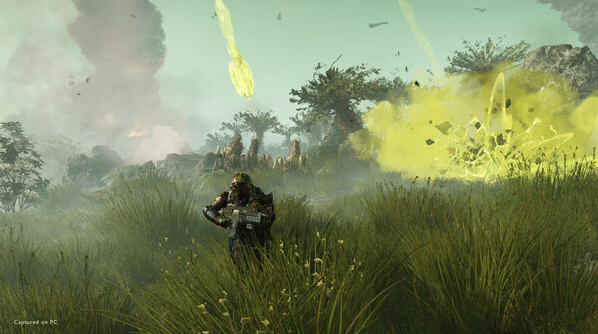
While Helldivers 2 initially enjoyed positive press coverage, and a reputation as a relatively unique live service game that didn’t nickel-and-dime its players, things have changed. It’s one thing to launch a new game, and it’s another thing to update and sell new features for it. If only because regular new content exponentially increases the amount of new bugs over time.
Helldivers 2’s Retention Rate Woes
Shortly after its launch. Helldivers 2 enjoyed nearly a half million concurrent players on Steam, but only six months later, it hovered around 20,000 to 30,000 players. That is a more than a 90% decline in the first six months after launch. While a decline in playerbase shortly after launch is normal and expected for live service games, this much of a decline within this timeframe is a financial concern: it’s a sign something notable was happening with Helldivers 2.
While a lack of information prevents us analyzing Helldivers 2 against a typical industry retention rate, you can compare it against a successful and long established live service game like Sea of Thieves (2018) to get a sense for how Helldivers 2 struggles to consistently retain players. I think Sea of Thieves is a useful benchmark, because it’s often seen as a successful live service game, with a still bright looking future, despite being on the market for seven years at this point.
Below is a chart plotting the player counts for both games since their initial release dates. If you’d like to interact with it yourself to dive deeper into the data you can do so at this link.

What is visually obvious, is that, relative to Sea of Thieves, which has been in the market since 2018, and is maintaining a healthy slow decline, is that Helldivers 2 has proven more fragile. Sea of Thieves peaked at 67k players post launch while Helldivers 2 was at 459k. But look at the player counts after 365 days. Sea of Thieves had 64k players and Helldivers 2 97k.
In other words, Sea of Thieves was roughly down 5% in player count after one year post launch, while Helldivers 2 was down 80% in player count in the same amount of time.
To underscore just how bad that decline is, Sea of Thieves’ current player count at time of writing is 10,000, which means, roughly, that it’s taken seven years to drop 85% in player count.
Thus, it’s no exaggeration to say that Helldivers 2 has taken months to lose similar percentages of peak players that a game like Sea of Thieves has taken multiple years to lose. That’s a bad sign.
The Billion Dollar Impact on Arrowhead & Sony’s Bottom Line
Losing players that quickly likely translates to $100s of millions of dollars in lost potential revenue for the short term, and likely billions over the lifetime of Helldivers 2. So, it’s obviously important for Helldivers 2 to work against this trend. Lots of money is on the table. There’s a leak here that, left unchecked, can and will drain a billion dollar reservoir drop by drop.
I don’t want to overstate the problem: again, player base decline is normal for live service games, especially sharp decline immediately after launch. The data above shows even Sea of Thieves faced a steep player drop months after its release. Helldivers 2 could survive profitably for years as a live service game with even only a couple thousand or ten thousands of players. Also, the data we can examine from Steam doesn’t capture the playerbase on PS5 or Xbox.
And, to be fair, Steam’s data since launch reveals Arrowhead has proven it can bring back a huge chunk of players with their major content updates. So things aren’t imminently dire. Arrowhead is in a safe position to determine what their best move is going forward. Helldivers 2’s bad retention rate is not an existential risk to the game by any reasonable standard.
But, it would be just as mistaken to understate the stakes. Relative to live service games such as Sea of Thieves, Helldivers 2 has proven more fragile and prone to decline. There are at least hundreds of millions if not billions of dollars of revenue at stake for Helldivers 2. Arrowhead and Sony’s financial future will be greatly affected by the fortunes of this game.
Ultimately, I think there are three different reasons why Helldivers 2’s retention rate looks so unhealthy compared to a healthy and established live service game like Sea of Thieves.
The First Reason for Helldivers 2’s Retention Rate Woes: Technical Debt, Bugs & Instability
As I mentioned earlier, one critical factor that made Helldivers 2 stand out on its release compared to other live service games, was the fact it was relatively bug free and stable. If you’ve played the game months after its release, especially as time went on, this was less and less true.
Eventually, this got so bad, that in September of 2025, Arrowhead’s CEO, Shams Jorgani, candidly admitted that Helldivers 2’s performance was “not good enough” and that Arrowhead was “trying to get their [s***] in order” to reduce the game’s “crippling” technical debt.
Helldivers 2’s Performance Is Suffering from its Successful Growth
Suffice it to say that as Helldivers 2’s rolled out successive content updates, Arrowhead naturally pushed the limits of the game’s technical foundation. In the words of the CEO Shams Jorgani, Helldivers 2 was created under the assumption it would sell to a more niche audience:
“[Helldivers 2] started as a AA game, then grew in scope […] The foundations of this big tower were made for a little bungalow on the beach. All this = tech debt = performance is so-so for us.”
Naturally, as the game’s performance and stability have deteriorated, the game has benefited from less positive reviews around performance compared to other live service games.
As a result, in October of 2025, the majority of Helldivers 2 recent reviews on Steam were Mixed. The review voted “most helpful” written in the last 30 days was negative, from a player with over 500 hours in game, who described the performance issues as just “inexcusable.” Player sentiment around all the performance issues is widely shared, if hyperbolic in its tone.
Arrowhead, as you would expect, has been candid in their public response to these issues. In the words of the game’s director Mikael Eriksson:
“After the last big update, Into the Unjust, we experienced more issues than what we were comfortable with. Players felt it, we felt it. I would say the feedback that we’ve gotten has been very justified […] We have made the decision to push some of our content, some of our featured updates, a little bit more into the future while we’re addressing these things[.]”
This is prudent. Helldivers 2 used to benefit from a good reputation for its stability performance that made it stand out next to its live service competitors. Generally, if Arrowhead wants a better retention rate for Helldivers 2, prioritizing stability is also the right move. Players won’t stick around to purchase new in game content if the game crashes or glitches frequently. New gameplay content doesn’t add value if it comes at the cost of reliable game performance.
Still, technical debt alone doesn’t explain why players turned so sharply against the game.
The Second Reason For Helldivers 2’s Retention Rate Woes: An Acrimonious Publisher & Developer Disconnect
Any discussion of Helldivers 2’s retention rate challenges cannot ignore how Sony and Arrowhead chose to publicize requiring account linking between Steam and Playstation.
How Sony Alienated Helldivers 2’s Playerbase One Month After Launch
To make a long story short, multiple business choices that Sony and Arrowhead made resulted in a situation where millions of Steam users who bought Helldivers 2 on PC were prevented from playing the game they purchased due to a policy enforcement change. This provoked review bombing against Helldivers 2 and permanently alienated many consumers. It was the first and early moment where the word of mouth around the game turned very sour.
Now, when I see most analysts covering this subject, they radically oversimplify the story. Headlines like these dominated the news cycle “Don’t Blame Arrowhead For Helldivers 2’s PSN Requirement, Blame Sony.” This is the narrative that most remember. It’s only half right. Sony and Arrowhead both made choices that created this controversy, even if Sony is arguably more responsible for turning an avoidable issue into a full blown marketing crisis.
If you start researching this subject, you’ll quickly learn that Arrowhead developed Helldivers 2 with the expectation from Sony that PC users purchasing the game on Steam would need to link their Steam account with a Playstation Account. This was always the plan.
Official Sony claimed the policy’s aim was to “protect players from griefing and abuse.” Unofficially, many inferred Sony’s primary motive was more likely to simplify collecting consumer data for their games, to sell to third parties, or use for internal business decisions.
However, as I mentioned earlier, Helldivers 2 was unexpectedly popular on release crashing all its servers. In the shuffle to fix that issue, Arrowhead relaxed the Playstation Account linkage requirement, because requiring account linking was making server issues worse.
In other words, Arrowhead chose to prioritize getting the game playable for more consumers over publicizing and enforcing Sony’s account linkage requirement. To be very clear, I’m not saying this was the wrong choice. It was probably the right call at the moment. It’s unclear whether Sony was consulted on this choice, though they publicly endorsed it eventually.
One month after Helldivers 2’s launch, Sony effectively endorsed Arrowhead’s policy enforcement decision. Consider the carefully worded language of Sony’s official announcement:
“Due to technical issues at the launch of Helldivers 2, we allowed the linking requirements for Steam accounts to a Playstation Network account to be temporarily optional. That grace period will now expire.”
So, Sony claimed to be aware of Arrowhead not enforcing Sony’s own requirement to link accounts. Effectively Sony endorsed Arrowhead making their “mandatory” policy merely voluntary. But once the servers stabilized, which is to say, once growth for the game stopped exploding unmanageably higher, Sony insisted Arrowhead enforce their linking policy.
Why Was Arrowhead Enforcing Sony’s Policy So Controversial?
To many, it seemed Sony wanted to have their cake and eat it at the consumer’s expense.
You see, when Helldivers 2 launched, there were 100 nations where you can’t legally have a Playstation Account, but you can have a Steam account. And if you lived in one of those nations, and bought Helldivers 2 via Steam, Sony requiring Arrowhead to enforce their linking policy, effectively prevented you from playing the game you purchased. In practice, it looked like Sony was taking money for a game they planned to remove consumers’ access to later.
And, for the people who did live in nations where you could legally have a Playstation and Steam account, it seemed like Sony was changing the terms of a sale retroactively. Some cited privacy concerns about giving Sony their data, others felt annoyed that they were being required to tediously link accounts when they could be…you know… playing the game. At best, it looked like Sony wanted to waste your time. At worst, it seemed like corporate surveillance.
In response, in just three days, Helldivers 2 received over 330k negative reviews on Steam, turning it from “Overwhelmingly Positive” to “Mostly Negative” on Steam.
During this crucial period, then CEO of Arrowhead Johan Pilestedt tweeted:
“We are talking solutions with PlayStation, especially for non-PSN countries. Your voice has been heard, and I am doing everything I can to speak for the community – but I don’t have the final say.”
Intentionally or not, Pilestedt thus effectively framed this issue as a dispute between Arrowhead and Sony where Arrowhead was on the consumers’ side, and Sony was not. As we saw before, this isn’t the first time Pilestedt publicly framed his own voice in criticism of Sony’s.
Likely inspired by their CEO, one day after Pilestedt aligned Arrowhead against Sony, Arrowhead’s Community Manager, “General Spitz” encouraged players in the official Helldivers 2 Discord to leave negative reviews on Steam of Helldivers 2 and request refunds, because it would give them leverage with Sony. Prudent or not, this is a practical suggestion if you’re a developer who’s willing to burn bridges with its publisher to do something for your consumer.
As you would expect, “General Spitz” was fired for saying the quiet part of Arrowhead’s CEO’s tweet out loud. Eventually, Sony caved in and prioritized protecting their new cash cow of Helldivers 2. They announced their mandatory account policy would now be optional again.
That said, executing this change took months. Steam, Sony and Arrowhead struggled to implement the new optional policy. Things were fine in nations/regions where you could have a Steam and PlayStation account, but not in the 100 places where you couldn’t get Helldivers 2 even if you already bought it. While this was eventually fixed, it hurt consumer trust further.
In sum, it’s fair to say Sony and Arrowhead’s choices hurt Helldivers 2. Sony seems by far the most to blame, while Arrowheads’ rapid public responses also amplified the fallout. Arrowhead opted for a confrontational approach, trading short term leverage, for long term trust.
This Fiasco Was Predictable & Avoidable
This fiasco was an avoidable positioning strategy marketing nightmare. There are multiple points where things could have gone differently that are worth learning from.
For example, when it was decided by Arrowhead/Sony to release Helldivers 2 on Steam as well as Playstation, it was possible to know that Steam accounts are available in some nations Playstation accounts are not. Helldivers 2 could have simply not been sold in those nations. This would have avoided creating millions of angry consumers unable to play a game they purchased.
Furthermore, Sony could have tried to use carrots rather than sticks. Sony could have, for example, worked out a deal with their developers, whereby players who voluntarily linked their Steam and Playstation accounts received some unique in-game cosmetic rewards. Everyone would win. Consumers would get rewards for giving Sony data, they would not feel blackmailed.
Finally, key employees at Arrowhead could have chosen not to make inflammatory, off the cuff remarks, framing the public narrative as a fight between the developer and the publisher. I realize hindsight is 20/20 but nonetheless, I think it’s fair to say Arrowhead’s then CEO and Community Manager framed the matter as an us vs them situation. Even if that was the power dynamic, this was not a diplomatic or prudent way to challenge it. Arrowhead was reckless, in a way that’s easy to understand given the unexpected and intense pressures they were dealing with.
Helldivers 2 already received 145,000 negative reviews before Arrowhead’s CEO tweeted his implicit support of player’s frustrations with Sony. “Spitz” encouraging this trend a day later only accelerated a review bombing trend that was already under way. Arrowhead didn’t need to implicitly, much less explicitly encourage players to vent frustrations to get leverage. They added fuel to the fire, publicly damaging their game and relationship with their publisher.
In short, there were many points at which Sony and Arrowhead could have de-escalated the situation. Face saving choices were rejected. Helldivers 2 was caught in a costly crossfire.
The Third Reason For Helldivers 2’s Retention Rate Woes: Vague Positioning & A Product Identity Crisis
Technical and organizational problems explain why Helldivers 2’s stumbled, but the real issue is conceptual. Arrowhead doesn’t know how to articulate the kind of experience it’s selling. They are passionate, and disarmingly candid (even to the point of profanity) but rarely precise. Their vision for the game is filled with contradictions that make marketing it an unenviable task.
Are Helldivers Disposable Grunts, Or Super Soldiers?
At the most basic level, it’s hard to tell what fantasy the game’s marketing aims to sell. Will Helldivers 2 make me feel like a cannon fodder grunt, or a soldier with exclusive equipment and training? And if I should feel both, which matters more, and how much?
Helldivers 2 is a bridge between two fantasies (the disposable grunt and the super soldier) each tugging in opposite directions. For now the bridge holds, but visible cracks are forming.
On the one hand, the in-universe storytelling constantly suggests you are disposable, but the moment to moment shooter gameplay revolves around exclusive stratagems and weapons. The developers seem to want to satirize militarism, but the gameplay rewards taking it seriously.
The marketing for this game diligently tries to split the difference: suggesting Helldivers 2 offers the fantasy of being a disposable grunt and a special operative. Many trailers depict Helldivers accidentally fragging themselves using gear you can purchase with microtransactions.
Ultimately, this design and marketing contradiction isn’t an accident, it’s a direct result of Arrowhead’s vision for the game. Johan Piledset explained the original concept like so in 2024:
“Helldivers [2] is a co-op action shooter where players are put in the shoes of ‘evil side’ grunts of pop culture. How would you fare as one of the ‘extras’ in your favorite 80s/90s action movie? Would you be able to survive a galactic war without plot armor to protect you?”
As an example of the grunts you would play as, Pilestedt references the Stormtroopers of Star Wars IV – A New Hope and the mobile infantry of Starship Troopers. If you watched either movie, you can guess the problem with using these movies “grunts” to inspire the Helldivers.
The Stormtroopers of Star Wars and mobile infantry of Starship Troopers are sometimes depicted as inept, disposable grunts, and sometimes as an elite group of special forces. It depends. Sometimes they are competent and deadly, other times they are lambs to the slaughter. Stormtroopers and Mobile Infantry have as much or as little plot armor as the story ever requires. The needs of the storytelling determine their efficacy, not game design, rules, or player skill.
It is thus no surprise that Helldivers 2 inherited this deep contradiction in its design and marketing. The core idea behind this billion dollar game is fuzzier than it should be. The game is like a building whose foundations were set well, but whose blueprints are unfinished.
Asking if I can outperform a disposable grunt suggests I can be a super soldier, if I am good enough. But it also suggests that, no matter what, I’ll find myself dying arbitrarily too. The end result is funny and empowering gameplay by design, that is also humiliating and frustrating by design. You are promised a chance to be more than a grunt and also intentionally denied that.
I’m not saying these ideas are insoluble, like oil and water. The tension between them is the fulcrum on which the whole games’ design balances. The issue is that it’s unclear which fantasy is the primary or secondary ingredient. Should I feel competent, but with flashes of foolishness, or typically inept, but occasionally badass? Helldivers 2 needs to pick one of these lanes. You get a radically different game depending upon which fantasy you design for.
Why the Super Soldier Fantasy Should Come First
Personally, I think it’s more prudent to prioritize the super soldier fantasy over the grunt fantasy. This would have direct design implications. Inexperienced players should often die like clowns. Only skilling up should keep them alive. And, sufficiently skilled players should never feel forced to die like clowns. There must always be some viable response available to a skilled player, some strategic move to overcome the odds, if only they learned and mastered it. Only then will it feel both funny and fair when the super soldier finds out they are just a grunt.
The super soldier fantasy is the first line on Helldivers 2’s blueprint. Everything else –the irony, the absurdity– depends on that line being bold. Start with satire, and you’re redrawing the foundation instead of building from it. That’s how you end up with a tower built on a bungalow.
Of course, Arrowhead may want to prioritize neither fantasy in the name of offering both. Or they may wish to prioritize the disposable grunt fantasy over the super soldier fantasy. It’s their prerogative to prefer these choices. That said, I’d strongly caution against both options.
Conceptually, Arrowhead might feel that oscillating between these fantasies is the point of Helldivers 2. But oscillation, by definition, requires movement around a central point. There has to be a primary fantasy the game can deviate from or the design becomes incoherent. Helldivers 2 needs a coherent identity. Without it, the game risks growing in contradictory directions, with developers working at cross-purposes, and the retention rate plummeting.
Creatively, Arrowhead wants Helldivers 2 to feel like a comedic farce. But there’s nothing inherently funny about being a disposable grunt who occasionally succeeds sometimes. That’s surprising for sure, but not humorous. In contrast, if I think I’m playing as a capable super soldier who is sometimes spectacularly humbled like a grunt, that’s the stuff of slapstick. The humor Arrowhead is interested in designing only works with a super soldier first fantasy game.
Commercially, a grunt-first fantasy also seems highly imprudent. The shooter market is already saturated with games that prioritize making players feel fragile, powerless, and interchangeable. All of those shooters implicitly promise you can be better than a grunt, too.
What gives Helldivers 2 a unique competitive advantage in the shooter market is its ability to primarily offer a super-soldier fantasy that is sometimes comically reduced to a grunt fantasy.
Ultimately, billions of dollars are at stake over this game’s lifetime. Conceptual, creative and commercial constraints all point to the same conclusion for Helldivers 2’s design. Arrowhead should prioritize the super-soldier fantasy over the disposable-grunt one.
Helldivers 2’s Fuzzy Creative Vision Creates Controversial Updates
Because Helldivers 2’s core fantasy is confused, many of its updates backfire. In the end, if I don’t know why you changed the game I play, I’m probably going to dislike the changes you made– if only out of a knee-jerk dislike for change, and for no other reason than that alone. Your changes won’t feel like a gift to me, but more like an arbitrary and irrational whim I suffer.
Helldivers 2’s ongoing updates are like a project stuck on the drafting table. Every time one designer reaches for the ruler to tweak, another grabs the eraser to remove something. Players who love the disposable grunt fantasy resent updates favoring the super soldier fantasy, and vice versa. And those who like the current balance dislike any and all structural changes.
This is why Arrowhead’s attempts to justify changes in terms like “fun,” “balance,” “realism,” and “believability,” backfire; everyone has a different idea of what these mean.
“Fun” is an emergent property, like birds flocking. “Balance” is also an effect of many things organized harmoniously. And what some find “realistic” others don’t and so it goes with “believability” too. These terms are fuzzy, feel-good words that hide more than they reveal. Everyone, developer and player, is invited to interpret whatever they want into trite buzzwords.
Arrowhead needs to stop marketing Helldivers 2’s unique fantasy with murky ideas like these. They must explicitly say how the disposable grunt and super soldier fantasy should relate. What fantasy matters more for Helldivers 2? How much more does it matter? Is one fantasy four times more important than the other, or merely three, or even just two?
My intuition is that roughly a three-to-one or four-to-one ratio of super soldier empowerment to disposable grunt absurdity is best. If “clownish and comedic deaths” fall much below 25% of the time, they stop feeling integral to the game; but if they occur much more often than that it begins to erode the sense that players are capable super-soldiers most of the time.
I’m not saying all players should die like clowns a fixed percentage of the time. Obviously, the ratio should shift to match the difficulty level players choose. The ratio I’m suggesting is a baseline rhythm – how the “Hard” difficulty (the midpoint between “Trivial” and “Super Helldive” difficulty) should feel for an averagely skilled player; someone who is neither a fresh recruit with fewer than fifteen hours in game, nor a virtuosic veteran with hundreds. (The most skilled players should always be able to avoid dying like clowns, unless they goof up.)
I don’t have a strong opinion on what the right ratio for the average player on “Hard” is, but Arrowhead needs to define one. This ratio has a direct impact on how Helldivers 2 plays. It determines how many minutes playing this shooter will feel like one fantasy vs another for most. “Balance” and “fun” are only meaningful terms when used in the context of specifics like these.
Without a clear vision, every update frustrates someone, and Arrowhead can’t justify changes or build loyalty: they can only oscillate between pleasing different factions.
Change is required. The live service business model demands it. Even if the core concept for a game like Helldivers 2 struggles to support updates that always leave someone unhappy. The bad retention rate stems from a conceptual problem rooted in vague and contradictory ideas.
Helldivers 2 Positioning Strategy Needs Thick, Not Thin Concepts
For Helldivers 2 to improve its positioning strategy marketing, I think Sony and Arrowhead need to work together to market a “thick” (not “thin”) vision for the game.
What Is a “Thick vs. Thin” Positioning Strategy?
I think it is easier to fix what’s going wrong with Helldivers 2 retention rate issues and messaging if you think in terms of “thick” and “thin” positioning strategy marketing.
I realize that might sound a little confusing, because I just used a piece of jargon from professional philosophy and the field of ethics to talk about marketing, but stick with me.
In philosophy, sometimes it can be helpful to distinguish talk about “thick” and thin” ethical concepts. A classic example of “thin vs. thick”: “good” is “thin,” but “courageous” is “thick,” because saying someone is “good” is less descriptive than calling them “courageous.”
A “thin” concept is like a loose carpenter’s joint, it can fit many places, but never snugly. A “thick” concept locks in place, its meaning holds because it’s shaped by a structure around it.
The loosey goosey nature of “thin” concepts is why crowds of strangers often disagree on how to define them. Their looseness makes them ineffective positioning language for consumers. “Thin” concepts invite people to interpret them in many different, even fully incompatible ways.
Returning to Arrowhead, I’d argue they rely on “thin” positioning strategy marketing. As we’ve seen, their creative vision for the game is sufficiently fuzzy as to be confusing. This is reflected in the Steam capsule & description of the game, a first impression swaying consumers.
Helldivers 2’s Thin Positioning Strategy Marketing:
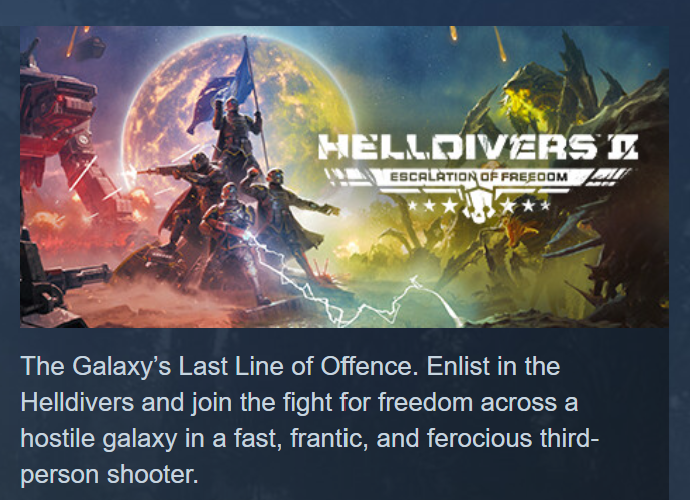
What can we tell based on the image and description? The game is:
- Sarcastic
- Sci-fi
- A third-person shooter
- And it emphasizes militarism and teamwork
The sarcasm is easy to miss, but must be intended with the play on “last line of offence [sic]” rather than the more conventional phrase “last line of defense.” Comedy is a selling point.
Unhelpfully, many of the same ideas are repeated in different words. Definitionally, most acts of “offense” involve “fights” and “fights” involve a “hostile” entity. The “fast, frantic, and ferocious” description is alliterative, but also tells us little new. I think most people expect hostile, fast-moving things to be ferocious and make us feel frantic. All that is common sense.
Because of the wasted words and ambiguous repetition, it’s unclear how this shooter will feel for players. This is “thin” positioning strategy marketing. The game is trying to mock militarism, and celebrate it, to empower and disempower. Who is it for? Who can say right now?
Sea Of Thieves’s Thick Positioning Strategy Marketing:
Compare this image and blurb to Sea of Thieves, a well established live service game that was originally released in 2018, and shows no evidence of declining any time in the near future.
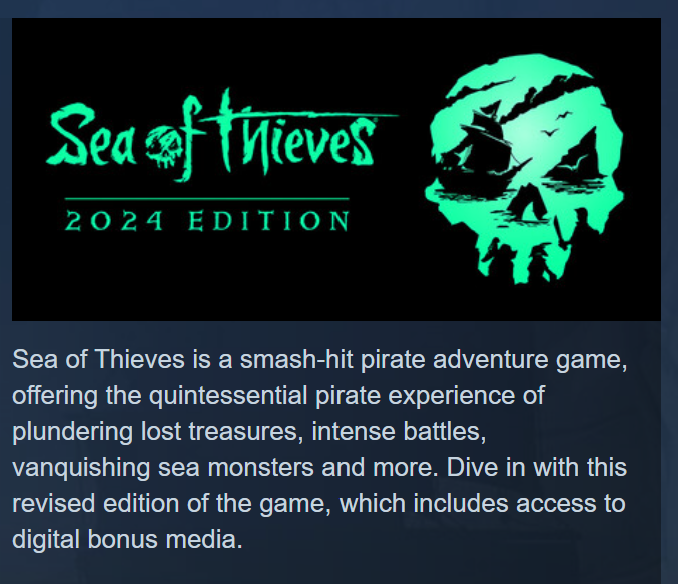
What can we tell, based on this image and description? Sea of Thieves is:
- cartoony and spooky
- a popular pirate themed game
- it offers adventure around lost treasures
- it also promises intense battles and sea monsters
The cartoony and spooky game aesthetic is recognizable in the image of the skull and font of the title. That it is a popular pirate adventure game involving looting, battle and sea monsters is explicitly stated. As a result, you can imagine what this game will probably play like.
Sea of Thieves’ positioning is upfront about what matters to the game, its cartoony and spooky pirate adventures which involve treasure, battles on the high seas, and aquatic monsters.
There aren’t wasted words; repetition occurs once and intentionally, only with the word “pirate,” which tells us that everything we see here is fundamentally helping us feel like a type of pirate. Presumably, a powerful pirate! We are empowered to adventure, defeat monsters, and win fights.
This is “thick” positioning strategy marketing. It’s not ambiguous, vague, or imprecise.
I don’t mean to suggest that Sea of Thieves hasn’t had its own controversies over the years, but judging by the numbers I shared earlier, it’s undeniable their retention rate is superior. Sea of Thieves’ “thick” positioning strategy is a key element behind their superior retention rate. Helldivers 2 has shed more players more quickly because of its far, far more “thin” marketing.
Helldivers 2 needs to embrace “thick” not “thin” positioning strategy marketing. If you’re curious what that should look like– I’ve written in detail about this subject elsewhere. Suffice it to say, that issue is nuanced and complex enough to deserve its own detailed article.
What Will Determine Helldivers 2’s Future
What Sony Should Do
Sony, for its part, needs to keep prioritizing the consumer experience over gathering data, while ensuring Helldivers 2’s positioning is thick and reflects its unique qualities. When confronted by things they don’t understand about Arrowhead’s choices with Helldivers 2, that means adopting a collaborative attitude, not asking its CEO “what the [f***] [he] was smoking.” Time will tell whether or not Sony is willing or able to make this adjustment with Arrowhead.
Also, it would go a long way towards restoring consumer confidence in Helldivers 2 if Sony could find a way to support Arrowhead in fixing the game’s crippling performance issues. One of Helldivers 2’s unique assets on the market was its reputation for high quality performance, and if Sony wants that reputation to return, Arrowhead could likely use more help. It’s only going to get harder for Helldivers 2 to maintain performance as the game grows larger.
What Arrowhead Should Do
Arrowhead, for its part, needs to keep prioritizing consumer experience as well, but should avoid letting that commitment blur into impulsive candor imprudently criticizing Sony. Arrowhead is already taking some big steps in this direction judging by recent announcements.
For example, Arrowhead’s new and current CEO, Shams Jorgani, has given credit to Sony for Helldivers 2 cross platform launch on Xbox, implying it wasn’t Arrowhead’s idea, and that players should really thank Sony. CEO Jorgani also went out of his way to be explicit that, although Arrowhead will fund its next game on their own, that this wasn’t a criticism of Sony.
This is a stark contrast from the public stances Arrowhead’s previous CEO once made.
Hopefully this reflects the growth of a more harmonious public and private business relationship. Time will tell whether or not Arrowhead is able to prudently temper its culture of candor.
At the same time, Arrowhead needs to double down on its commitment to stability.
Stability isn’t sexy, it doesn’t look like it sells microtransactions, but without it, players leave.
Arrowhead needs to prioritize the high level of polish that initially made their game stand out.
Why Sony & Arrowhead Should Embrace Thick Positioning
Sony and Arrowhead both can do things to embrace a “thick” positioning strategy for Helldivers 2 rather than the “thin” one which currently undermines this unique game. Helldivers 2 can’t be all things to everyone, nor should it, if the aim is maximal reliable revenue over time.
Helldivers 2 will continue to disappoint without “thick” positioning strategy marketing. And while things are by no means dire, there’s little reason to leave money on the table either. Not when we are talking about billions of dollars of revenue over the lifetime of Helldivers 2.
I hope Helldivers 2 figures out its growing pains so I can update this article with an inspiring turnaround story — the kind where you can see the weld marks, but the structure stands stronger and more beautiful for them. If Sony and Arrowhead can align their blueprints and seal the leaks, the game won’t just stand out, it could soar above to define the market of the 2020s.
Normally, live service games are heavy on marketing and light on innovative game design. Helldivers 2 did the opposite, which has its own flaws. Yes, good marketing can’t replace a quality product, but a quality product needlessly suffers without good marketing.
Helldivers 2 shows how challenging it can be for teams to articulate what makes a product unique, even when they philosophically value focusing on what differentiates them.
At Insight To Action, one of our skills is helping brands refine “thin” positioning strategies into “thick” ones. If you’re looking to learn more you can read examples in our Positioning Strategy Resources, or get insights from our experts by subscribing to our newsletter.
