

Executive Summary: CPG food and beverage companies of varying sizes —from PepsiCo ($92B) to Kraft Heinz ($25B) to smaller $500M+ brands—are finding value in AI for marketing, sales, and insights work. These AI examples for CPG food and beverage reveal the ways brands are having breakthrough success with AI. Plus, see the AI pitfalls leaders warn executives to watch out for.
Is Your Brand an AI Scale Leader? A Proprietary Development Powerhouse? Or a Well-Rounded AI Implementer?
Leaders at consumer packaged goods (CPG) food and beverage companies like PepsiCo, Kraft Heinz, Bordon Cheese and two other $500 million+ organizations are aggressively pursuing opportunities and overcoming challenges to leverage AI for growth and increased effectiveness. These AI examples for CPG food and beverage focus on AI use in the marketing, sales and insights areas.
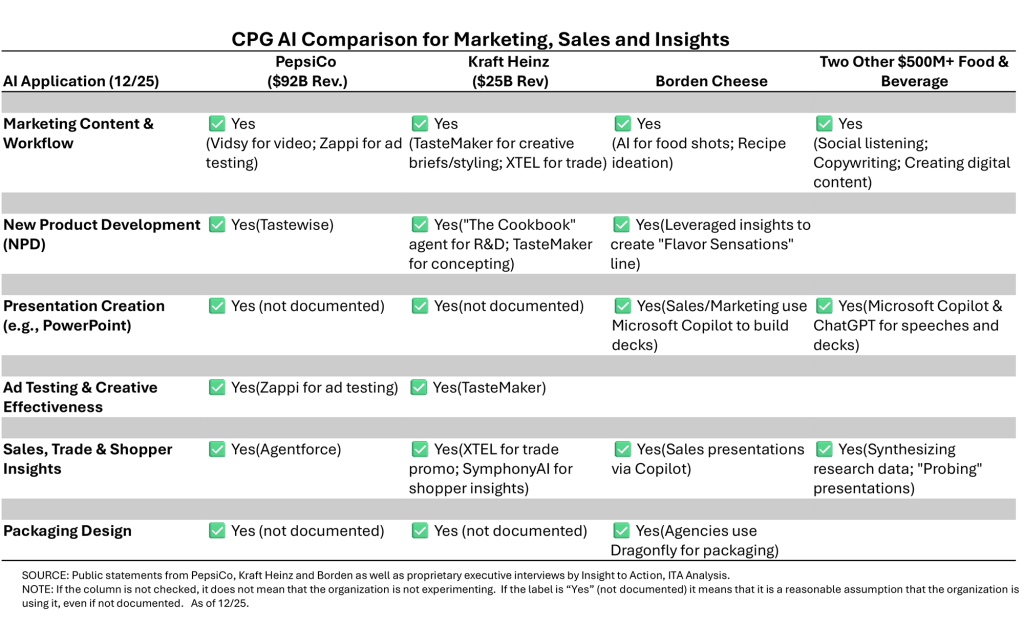
Let’s look at some of the top applications that are proving fruitful and those that are lagging, according to these leaders as well as claims that leading CPG companies are making about their use of AI. Here’s an overview chart of our AI examples for CPG food and beverage:
AI Examples for CPG Food and Beverage:
PepsiCo as AI Scale Leader
As a point of reference, PepsiCo’s past 12 month revenues in September 2025 were $92 billion, and its 2024 advertising spending was $3.9 billion. That makes PepsiCo the largest organization considered in these AI examples for CPG food and beverage.
In the sales, marketing and insights AI domains, PepsiCo recently announced the deployment of Salesforce’s agentic AI solution, Agentforce. Says PepsiCo Chairman and CEO Ramon Laguarta:
“AI is reshaping our business in ways that were once unimaginable…This collaboration with Salesforce is another step toward a more connected and adaptive PepsiCo ― deploying AI to unlock smarter and faster decision-making, fuel innovation, and power sustainable growth.”
In addition to the Agentforce deployment, partner applications that PepsiCo is touting on PepsiCo Labs include:
How Does PepsiCo Integrate These Various AI Applications?
PepsiCo marketing and insights AI examples using these partners’ products cover a broad range of areas including:
- Ad Testing:Zappi’s Amplify TV testing system for the ADA platform saw a 30% increase in effectiveness of the content of the creative work. This is according to PepsiCo SVP, Chief Consumer Insights and Analytics Officer Stephan Gans. Gans says “Every time we test an ad, the whole PepsiCo gets smarter.” With PepsiCo ad spending of $3.9 billion, this type of improvement is quite impactful.
- Interestingly, Gans is the co-author of The Consumer Insights Revolution: Transforming Market Research for Competitive Advantage along with Zappi CEO Steve Phillips and Appcues CEO Ryan Barry. In December 2022, privately held Zappi raised $170 million.
- Video Ad Optimization: Vidsy “video production solution allows marketers to create effective video ads, easily and efficiently across digital.” According to PepsiCo, 45 brands are using this application.
- New product development and monitoring trends. PepsiCo VP Insights and Marketing Capabilities Europe Monico Tenorio shared an industry panel with Tastewise to discuss how “AI allows for forecasting key trends to influence product development and overall food sales.”
- Targeted launch of new products. Back in 2017, PepsiCo identified the 24 million US households that represented the best targets for Quaker Overnight Oats. Said Jeff Swearingen, former SVP of Marketing at PepsiCo, “We were able to launch the product using very targeted media, all the way through targeted in-store support, to engage those most valuable shoppers and bring the product to life at retail in a unique way. These priority customers drove 80 percent of the product’s sales growth in the first 12 weeks after launch.”
What Is PepsiCo’s Overall AI Strategy?
Taking a step back from these AI examples for CPG food and beverage, a 2025 Forbes article outlined PepsiCo’s overall AI strategy, led by Dr. Athina Kanioura, Chief Strategy and Transformation Officer at PepsiCo. Prior to joining PepsiCo in 2020, Kanioura’s background was 16 years of consulting at Accenture with practice specialization in Analytics and Applied Intelligence.
Three highlights of PepsiCo’s announced AI corporate approach from the Forbes interview are:
- Align on a core set of implementations that any function can reuse, and avoid “1000 AI pilots.” The goal is for 70% of top-enterprise processes to be shared across the organization.
- Use the five PepsiCo “business priorities” to guide AI. These are: consumer closeness, commercial excellence, operations, integrated business planning and employee experience.
- “Buy the tech, own the process.” “We buy your products. If we don’t influence your product roadmap, we are not interested,” Kanioura said, “We define the release cycles… based on our requirements.” for platforms like Salesforce, AWS, Microsoft, ServiceNow, Nvidia and Siemens.
From this information, it’s evident PepsiCo is operating as an AI Scale Leader using the Bain AI maturity framework. For readers seeking to explore additional AI applications, Bain identifies numerous AI “marketing” (and other) applications including:
- Marketing and media mix optimization
- Measuring brand exposure and perception
- Creating personalized content (create dynamic landing page)
While we didn’t run across AI examples for CPG food and beverage of any of these Bain applications, undoubtedly they exist.
AI Examples for CPG Food and Beverage:
Kraft Heinz Boosts Marketing Effectiveness with AI
At $25 billion in annualized revenue, Kraft Heinz, while still very large, is approximately 27% of the size of PepsiCo. Kraft Heinz advertising investment was approximately $1 billion in 2024.
Kraft Heinz is also in the process of splitting into two (still very large) entities in the second half of 2026.
Like PepsiCo, there are numerous AI examples for CPG food and beverage in Kraft Heinz applications, not limited to marketing, sales and insights.
Kraft Heinz marketing and insights example applications include:
1. Optimizing Marketing Workflow, Including Creative Brief, Testing and Food Styling
Justin Thomas, Kraft Heinz Global Head of Digital Experience and Growth explains,
“At Kraft Heinz we want to be the most creative, consumer obsessed food company. And when we think about food, just like creative, it becomes a matter of taste. And taste is shaped by culture, intuition, experience…The human and the technology. Tastemaker is our marketing platform specific to our marketing community at Kraft Heinz.…Ability to augment and accelerate our creativity at Kraft Heinz…
First pilot in August 2024. And it started by just a question, somebody in our marketing community…First thing we did was brief generation, a very manual effort, not necessarily a loved task…People got very excited by the first pilot of brief and concept imagery….Another part was creative evaluation. Can we look at how we use AI to pretest whether the creative is right for our brand, consumer, culture? Lastly, how we bring our brands to life. Food styling can be very time consuming and expensive. A really exploratory journey for us….Brand intelligence…bring that into TasteMaker and generate a really rich reference library, our best campaign, style guide, consumer data…”
According to the case study from ApplyDigital, Kraft Heinz has reduced time-to-market by 80% and TasteMaker has been adopted by 60% of internal Kraft Heinz team members. Not to be confused with Tastewise (which PepsiCo uses), Kraft Heinz’s TasteMaker is an internal, proprietary AI program that uses:
“BigQuery, Vertex AI platform, Gemini, Imagen, and Veo to speed product concepting and marketing content development.”
2. New Products Go-to-Market Faster Thanks to AI Agent
Kraft Heinz developed “The Cookbook” AI agent to help R&D and marketing teams bring new products to market faster. Says Kraft Heinz Head of Decision Intelligence Products and Platforms Pat Nestor,
“The Cookbook also leverages existing documentation and digital data systems, which has been critical in helping our team understand potential knowledge gaps as we continue to build out the database that informs the tool.”
3. Trade Promotion
Kraft Heinz EMEA region uses the XTEL trade promotion management solution, described as:
“Drive trade ROI up with effective promotion planning and execution. Maximize the ROI of trade spend with each customer while boosting the effectiveness and productivity of your trade and account teams.”
4. Shopper Insights and Category Management
Kraft Heinz worked with SymphonyAI to strengthen shopper focused retail partnerships.
Kraft Heinz’s innovation strategy is to be “Agile@Scale”. Looking at the publicly-available information, Kraft Heinz appears to best fit Bain’s AI Focus Leader profile with several well developed use cases (e.g., TasteMaker).
Both Kraft Heinz (KHAI) and PepsiCo (Ada and PepGenX) also have their own internal general purpose “answer engines” using generative AI.
AI Examples for CPG Food and Beverage:
Borden Cheese Employs a Well-Rounded AI Approach
The Borden Cheese brand was created in 1857, and a lot has changed in the world of cheese in the intervening 168 years. I interviewed Jenny Mehlman, Senior Director of Marketing, about Borden Cheese’s AI use. The brand is integrating AI tools into four key areas.
How Is Borden Cheese Improving Marketing Outcomes with AI?
When it comes to marketing and insights, Borden Cheese is utilizing AI for a number of applications. Here are four AI examples for CPG food and beverage with Borden:
- Optimizing marketing workflow, including AI-created visual imagery and packaging mockups. Says Jenny Mehlman, Senior Director of Marketing:
- “We have been testing AI when we need quick, quality content.. We tested Dragonfly for packaging development this year and it helped us fine-tune detail. We are learning ourselves, but marketers don’t have time to figure it all out. People are experimenting with AI, if an agency isn’t bringing it to you, ask about it.”
- AI for brainstorming and ideation for brand collaborations and recipe development.
- Mehlman explains, “For instance with brand collaborations as a test exercise, think of for itself or pop it in. Luxury company. What if it was Rolex? Create an image to pitch that. Another use is to go to it for starting recipe ideas, recipe development. Then hand the ideas to a recipe developer. In the world of food, there are so many ideas.”
- New product development. Borden Cheese leveraged deep consumer insights and monitoring of trends with AI to create its new, spicier line of sliced cheese. The Flavor Sensations line includes Jalapeno Jack and Habanero Cheddar.
- Jenny Mehlman stated: “consumers are seeking new culinary experiences during mealtime, and the Flavor Sensations line aims to cater to this desire.”
- Building presentations using Microsoft Copilot. As the team continues to explore new opportunities, Borden Cheese Marketing and Sales team members are using Copilot to enhance presentations. Many organizations are standardized on Microsoft 365 and are using Copilot for everyday work such as Powerpoint presentations. We previously explored the revenue from Copilot.
AI Examples for CPG Food and Beverage:
Two More Brands
We also spoke with marketing and insights leaders at two other food and beverage brands, both with revenues over $500 million. Here are these AI examples for CPG food and beverage:
- Building and enhancing presentations using Copilot ChatGPT. Examples from our interviews with food and beverage leaders:
- “I’ve been doing this for years. First time I recall distinctly 2 ½ years for a sales presentation. I asked ChatGPT to write my speech, It did a pretty good job, then I sent it to the Internal Communications person to edit.”
- “Another application of Copilot is data storytelling and visualization with Powerpoint decks. ‘How would you rearrange this slide?’ ‘Map out visually the story depending on the audience, CEO.’”
- Creating digital content. “I know the teams are using ChatGPT or CoPilot to create digital content. I was impressed by the quality.”
- Summarizing existing insights and generating questions about existing research. Says one beverage insights leader:
- “One of the best use cases for insights across the whole company. Synthesize across the whole company. Data library for the whole company, parse through all the research and ask a targeted question, ‘What are the five most important things about the consumer to know and why?’”
- “Also useful to probe a little more, run the presentation through Copilot, use it to probe any other what outs and what should we apply for the future.”
- Copy development and Social Listening. “Marketing is using it for copywriting, and maybe competitive landscape reviews, social listening. However, the company as a whole is skeptical about the quality of the information. We’ve been told ‘just use Copilot”.
6 AI Pitfalls Leaders Warn Executives to Watch Out For
- Avoid overinvestment in a solution that doesn’t fit their organization.
- “For us, Salesforce is overengineered and too expensive. Agentforce would be the same.”
- Didn’t deliver results for your organization.“
- We did explore using AI for creative iterations and ads. The pilot we were using wasn’t that advanced, and it didn’t work.”
- Concerns about external partner use of the brand’s data to benefit other organizations.
- “Our creative agency wants to create their own AI tool and use all our raw data. We’ve pushed back and how it will be used. Is it proprietary? We opted out.”
- Failure of digital twin for ad testing and new product concepts.
- “Worked to create a digital twin, feeding in the quantitative and then old transcripts from qual. Create a secondary AI audience and then test it. Not so useful because we need to refresh it with new data. It was not picking up on the nuances of that consumer. Maybe if we synced it with a social listening tool. Found it was too static. So we can not use it for innovation and ad testing.”
- Qualitative research lacks the human touch for interactive focus groups.
- “It’s more suitable for one-on-ones.”
- Microsoft Copilot is the corporate choice, and is preferred for its security, but doesn’t deliver a ton of value beyond presentations.
- “In the last 9 months, I have heard a lot about Copilot. We hired a guy responsible for AI, and he gave a speech. It comes across that the premise of AI is Copilot use.”
- “Do you remember Clippy from Microsoft Word? That’s how the Copilot popups are behaving for me. From a marketing leader’s perspective, I had to call IT to disable Microsoft Copilot. If I were going to look for something bigger, I would start with AI to increase in productivity and plans but not Microsoft Copilot.
These pitfalls are real, as a recent MIT report found 95% of generative AI pilots at companies are failing.
While it didn’t come up in this research, we find the GEO impact on marketing’s organic search is significant. For those with organic search as an important part of their marketing strategy, we recently explored how GEO (generative engine optimization) has changed traditional SEO (search engine optimization).
With 20% of the Boston Consulting Group’s revenues in 2024 coming from AI Advisory Services, there is a lot of interest in this topic from CPG clients and other organizations. We’d love to hear from others about their perspective on this topic.
Contact us to share your perspectives, or if you’re looking for AI insights for CPG food and beverage. Subscribe to our newsletter for in-depth articles from our experts.
