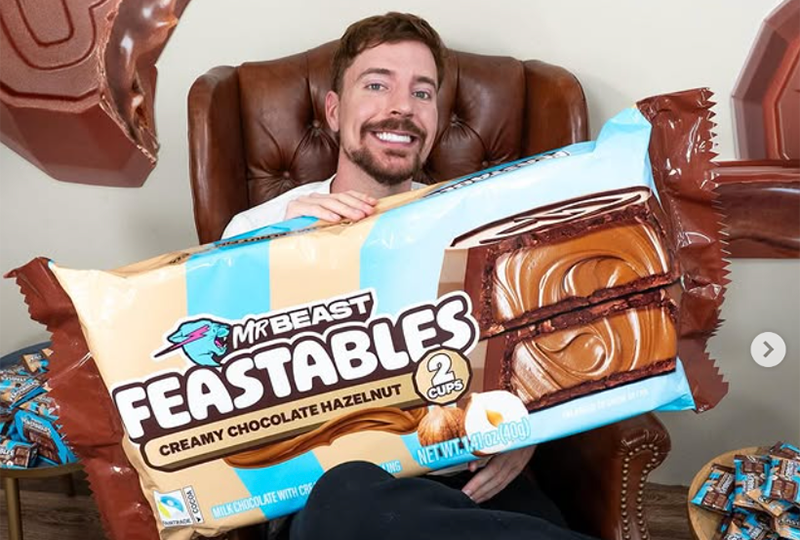
Executive summary: MrBeast demonstrates audience-led brand diversification: after building massive reach through content, he leveraged his own media to launch Feastables, a completely different product category marketed directly to the same audience. We discuss three brand strategy examples from Feastables: use of existing audience, aligning brand identity, and understanding existing consumers.
How This Emerging BFY Candy Brand Landed on Major Retail Shelves
Lately, I’ve been seeing more and more of a candy called “Feastables” in my local CVS and at grocery stores. This candy was actually created by the world’s most famous YouTuber, MrBeast. Today, we’ll discuss MrBeast, Feastables, and the brand strategy examples which have helped Feastables contribute to a $5 billion dollar valuation of its parent company, Beast Industries. The Feastables brand strategy relies heavily on intertwing the public image of the chocolate company with the existing MrBeast brand.
Who Is MrBeast?
To understand Feastables, we need to know a few things about the MrBeast brand. MrBeast, or James Donaldson, is an American YouTuber with the largest audience on the platform. He has 464 million subscribers (about 6% of the world population), and his most popular video has 904 million views. A more typically permorning MrBeast video has about 100 million views: comparable to the number of people who watch the Super Bowl every year (according to the NFL).
Donaldson’s videos are competitive, extreme, and sensational (recent titles include “World’s Strongest Man Vs. Robot,” “I Survived 100 Hours in an Ancient Temple,” and “Would you Risk Dying for $500,000?”). They feature clickbait thumbnails of Donaldson himself making exaggerated facial expressions. The thumbnails always include bright colors, and the contestants in Donaldson’s videos are often in brightly-colored jumpsuits: the videos look like something between a game show and a children’s program.
Who Are MrBeast’s Fans?
Indeed, Donaldson’s content is de facto children’s programming. According to the website tubefilter,
“Most of MrBeast‘s audience (75%) is male, and the most common age demographic among his fans is teens between the ages of 13 and 17. They account for 39% of his viewers.”
The next largest category is ages 18-24, who account for an additional 20% of his viewers. In short, Donaldson has a massive platform on which to advertise any product to a group of mostly children and young adults.
The Beginning of MrBeast as a Brand Strategy Example
The opportunities for monetization seem obvious when we look at Donaldson’s current platform, but one aspect of this brand strategy example that began prior to the development of Feastables was his very early partnership with sponsoring brands, allowing him to make videos with much higher budgets than he likely could have afforded earlier in his YouTube career.
This high budget itself seems to be part of the strategy of garnering attention (note for example the $500,000 dollars specified in the video I referenced above), so monetizing his YouTube videos not only allowed Donaldson to leverage his brand to make money, but in many ways allowed Donaldson to create the high-budget brand of MrBeast. As two authors on the blog The Future of Social write,
“the philantropic (sic) mechanism that became core to MrBeast’s channel [is] building on revenues from advertising and sponsorship to shoot massive giveaways. Philantropy (sic) as a virality generator.”
Using sponsor money is actually baked into MrBeast’s brand strategy.
Brand Strategy Examples: MrBeast Feastables Stay True to His Audience and Brand
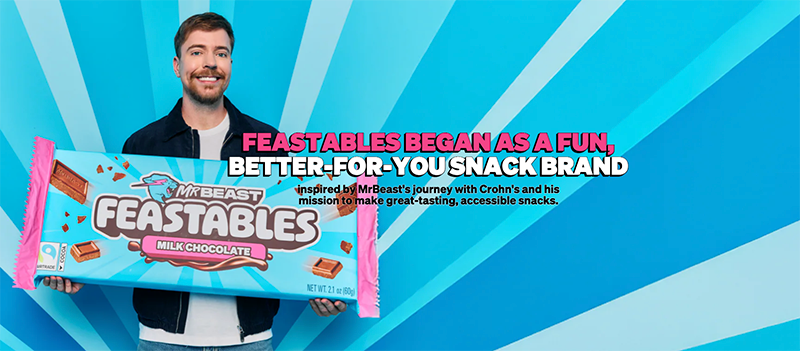
Enter Feastables. Launched in January 2022, the original press release focuses on:
“ the mission to deliver high-quality snacks to the masses.”
Feastables began as a BFY (better-for-you) chocolate brand, with Donaldson frequently comparing the bars to Hershey’s chocolate as an advertising tactic. They are tightly linked with the MrBeast brand: each package includes the MrBeast logo, and the bars are wrapped in a teal plastic, matching a color Donaldson often uses in his videos.
Today, I’d like to highlight three elements as brand strategy examples, going into how Feastables leverages the connection with MrBeast.
- First, Feastables built an existing audience that was familiar with an existing brand to create a new brand.
- Second, Feastables fits in with the MrBeast brand identity.
- Third, the Featables brand strategy shows an understanding of MrBeast’s main audience, which is children.
Same Audience, New Product: An Offerings Expansion Brand Strategy Example
The first brand strategy example from Feastables is the use of an existing audience or group of customers to sell a new product. Our Insight to Action article “Brand Strategy Template for Launching a New Product” describes this approach as “Offerings Expansion Only.”

MrBeast was already a top YouTube channel by 2022, and each video on the MrBeast channel can serve as free advertising for Feastables.
Feastables are often integrated into MrBeast’s videos — a cross between product placement and traditional advertising. On the one hand, it is not easily skipped or muted and seems authentic or unforced, and on the other hand it is often explicitly promotional, with participants in MrBeast’s challenges often remarking upon how good the Feastables products are.
Four out of five of the most popular MrBeast videos released after the launch of Feastables mention the chocolate bars, with an average 1.8 mentions of Feastables per video.
- One video includes a segment with seemingly random people trying Feastables and saying how good they are.
- Another segment promotes Feastables with a ‘secret’ MrBeast video only available to people who scanned a QR code on a Feastables bar within the next 30 days.
- Another video features Donaldson and friends using Feastables to make smores as a treat while stuck on a desert island.
The way that Donaldson integrates Feastables into the MrBeast videos is a key part of this brand strategy example. Not only is it free advertising, but Feastables become part of the MrBeast brand and benefit from the existing MrBeast fanbase.
A Brand Strategy Example Featuring Ethics and Philanthropy
Relatedly, another element of the Feastables brand strategy example is the way in which Feastables’ ethical sourcing ties into the philanthropic brand image of MrBeast. The very first press release mentions that the chocolate company will:
“sustainably source their cacao and support their mission to create a sustainable future for people and nature, and the brand will ongoingly support Beast Philanthropy with food and cash donations to continue to address food insecurity in the United States.”
The company has expanded upon the ethical elements on Feastables with a new focus on ethical sourcing and paying fair wages to chocolate farmers. The “Our Cocoa Story” page of the Feastables website reads:
“We Still Bring The Fun – Now With Bolder Flavor And A Bigger Purpose. From chocolate bars to cups and beyond, every bite helps build a better future for the people behind it.”
While most children are probably not terribly worried about whether their chocolate is fair trade and sustainable, as MrBeast’s brand involves philanthropy, this ethical sourcing element does help Feastables fit in.
Furthermore, MrBeast has made philanthropic content related to the ethical chocolate sourcing: you can see some of the same footage in his How Feastables Chocolate is Made video and his Click This Video To Feed 1 Person video.
A Brand Strategy Example with a Taste that Appeals to Youth
Finally, Feastables provide a brand strategy example in understanding one’s consumer base. As mentioned above, most MrBeast viewers are children or young adults, and the viewership skews male. In addition to BFY and ethical elements, the Feastables branding and advertising also focus on taste, which appeals to everyone but might especially be important when marketing chocolate to children.
There are many videos comparing the taste of Feastables to other chocolate brands, especially Hershey’s, including one with Gordon Ramsey: Gordon Ramsey Decides Feastables vs Hershey’s – YouTube. Feastables always win in the end.
In addition to comparing their chocolates favorably to others, Feastables also seems to offer simple, crowd-pleasing flavors that might appeal to children, such as hot cocoa, cookies and creme, peanut butter, and the like. Finally, in the past, Feastables also appealed to a juvenile sense of humor with a peanut flavor called Deez Nuts, although they were forced to change the name due to a lawsuit brought by Dee’s Nuts.
The gamification and giveaways associated with Feastables also seem to be an attempt to appeal to the MrBeast audience, as MrBeast’s videos often involve games and giveaways.
What’s the Final Word on MrBeast’s Feastables?
With a regular viewership comparable to that of the Superbowl ready for free advertising, Donaldson has managed to create a product in a category totally distinct from his previous offerings and integrate the new brand seamlessly into the MrBeast brand. A 2025 FastCompany article reports that Feastables brought in over $250 million in revenue in 2024. This is a fantastic brand strategy example to learn from.
For more information on brand strategy, including lots of examples from the food and beverage industry, as well as posts on growth strategy marketing, customer segmentation, positioning strategy, and more, see our resources page. We also offer a newsletter, your go-to source for the ever-evolving world of market strategy. We hope to hear from you soon!