
Executive summary: The market size for personal development and dating is large, but many Americans still report increasing loneliness, and marriage rates are decreasing. Met Through Friends offers a useful example of product innovation strategy with its Plus-One Party, which responds to issues of adverse selection in the dating market by leveraging the existing social capital of friendships to improve dating events. By selling tickets only to pairs of friends, the Plus-One Party improves participant selection, strengthens behavioral norms, and creates a more relaxed and trustworthy environment.
Can Bringing a Friend to a First Date Improve Your Chances of Love?
Just in time for Valentine’s Day, I recently found myself at a singles mixer. However, instead of trying to find a mate, I was trying to understand a business: Met Through Friends. Established in 2024, Met Through Friends is the brainchild of Elle Wilson, a Stanford grad turned dating coach and entrepreneur. Over the phone and at the event, Elle Wilson explained her innovation strategy to me, and what makes Met Through Friends different. Today, we’ll discuss the dating and mating industry, and describe how Met Through Friends can be understood as a kind of product innovation strategy in the dating market.
Big Money in the Romantic Recession
Met Through Friends is a new startup entering into a very large industry. According to Grand View Research, the global online dating market is worth around $10 billion, and they estimate that the broader personal development market is worth around $50 billion. Within the category of dating, personal development offerings include:
- advice books
- dating and/or relationship coaching
- online dating apps
- singles mixers
- matchmaking
At the same time, some experts claim that the United States is in a “romantic recession.” Marriage rates are especially declining for people without college degrees. For all Americans, the age at first marriage has risen about six years in the last hundred years.
This pattern of depressed marriage rates and higher age at first marriage is not uniquely contemporary as some might think, having occurred in early modern Europe. But loneliness and disconnection seem to be pressing social issues. More than half of all American adults report feeling disconnected some or all of the time, according to the APA in 2025.
So, the market for personal development and dating products is large and growing, and there seems to be more demand than ever in the form of loneliness.

Product Innovation Strategy Example: The Plus-One Party
In this context, Wilson noticed firsthand that her friends were struggling to find connection even with the help of dating apps, and began throwing singles parties. From there, the central innovation of Met Through Friends was born. The events Wilson organizes are centered around using friends to find love.
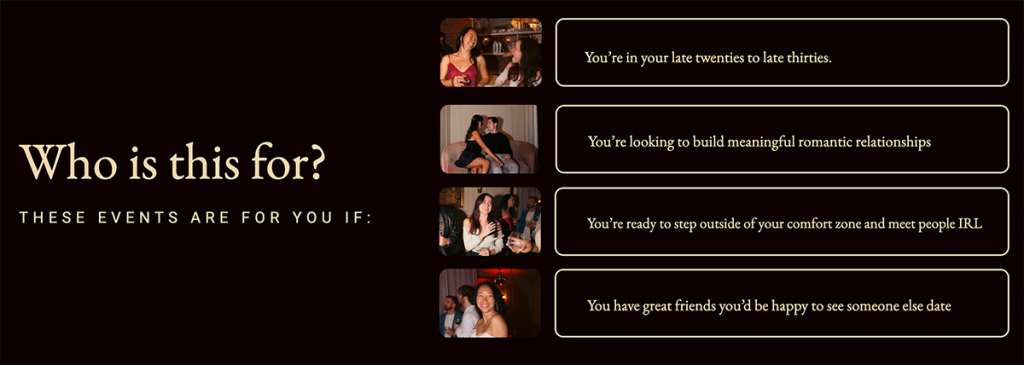
At Plus-One Parties, the main new product of Met Through Friends, all attendees must come in pairs, bringing a friend of the opposite sex. At other events, such as their Pitched Through Friends events, some people sign up to give a presentation on a friend, while others can join the audience. In both instances, the focus is on bringing people together romantically using their existing friend networks.
How does all of this differ from a dating app or a normal speed dating event? The Plus-One Party that put Met Through Friends on the map innovated in response to a set of real problems in the dating market. For example, dating apps suffer from adverse selection. Jadrian Wooten writes for the Monday Morning Economist that because some people lie on apps, the whole market can be poisoned. He explains:
“overly curated profiles promise more than they can deliver. This mismatch in expectations can discourage genuinely good matches from sticking around, leaving the market flooded with less desirable options. As the high-quality matches log off the app, the only people left are matches that are less likely to result in successful relationships.”
How This Innovation Strategy in Dating Fixes Adverse Selection
Met Through Friends solves these sorts of selection problems by embedding screening into the Plus-One Party. Tickets are only sold in pairs to one heterosexual man and one heterosexual woman (or in other cases, two lesbians, etc.). This can all be understood as a kind of product innovation strategy. By creating a new barrier to entry for participants, the event itself is altered in a few key ways.
- Everyone who attends can maintain a friendship with someone of the opposite sex — advantageous selection for better participant quality
- Everyone who attends has friends and is willing to go out with them — advantageous selection for better participant quality
- The environment may be more relaxed, as people do not have to go alone, and the wingman can create comfort — better experience quality
- Genders are balanced by design — better experience quality
- The wingman also creates accountability —protects behavioral norms
All of this changes the product being sold, which is a ticket to entry to the dating event. Participant quality, experience quality, and behavioral norms are all improved.
I saw this firsthand at the Plus-One party that I attended. The event was held in the cozy back rooms of Lou’s, a Cambridge restaurant. Participants arrived with their friends and appeared to stick together through the initial cocktail mixer, some even feeling comfortable to ask me just what I was doing there. Because the genders were balanced, no one was left awkwardly alone for any length of time during the speed-dating portion of the event. The event felt relaxed and natural.
In short, by creating the Plus-One Party, Met Through Friends was able to add value to their product (without imposing any additional cost, as the design leverages existing friendships).
Service Innovation Strategy in Plus-One Parties
Met Through Friends also incorporates some service innovation, because the service they sell is a little different than a normal singles mixer. For example, the genders are balanced by design (not so at every speed dating event or singles mixer). Wilson also provides a little coaching in the form of a pep-talk at the beginning of the event and some good conversation prompts on the tables. The format includes an unstructured mixer at the beginning, a speed-dating section, and an unstructured mixer at the end.
Met Through Friends could incorporate even more service innovation strategy by leveraging the pairs of friends further, for example by changing the set-up of the speed dating events to incorporate the wingmen. However, currently the strongest focus is on product innovation strategy.
Innovation Strategy Helps Brands Soar into the Future
We can see the innovation strategy of Met Through Friends clearly: the Plus-One Party represents an improved product, meant to address some of the key issues in the dating market today. To see more examples of innovation strategy, you can also check out my articles on incremental innovation and vintage innovation.
In a way, the Plus-One Party can be understood as incremental innovation (making a small change to an existing product) and vintage innovation (using an old technology, friendship, to solve a new problem). Met Through Friends’ innovation strategy helps this brand overcome current dating market challenges to be a successful model in the future.
Insight to Action can help you find the innovation strategy that is right for your company. To learn more about innovation strategy, brand strategy, new products, and more, please check out our blog, and see our resources page for more ways to connect with us.