


Executive Summary: In this real estate trends article, we discuss buyer’s markets, including what defines a buyer’s market, four signs you are living in a buyer’s market, how a buyer’s market affects buyers, when to buy, and strategies for buying in this type of market. Whether you are a first-time home buyer or an experienced buyer, learning about the overall market can help you make a better decision.
What Homebuyers Should Know About Today’s Real Estate Market
In real estate trends, what is a buyer’s market? This market condition exists when there are more homes for sale than homebuyers in a given area. My recent Redfin Blog article with Amanda Tripp explores the general criteria for a buyer’s market, along with recent real estate data across the US. If you’re a homebuyer, you’re wondering, “Am I in a Buyer’s Market?”
While real estate experts are aware of the key measures defining a buyer’s market and a seller’s market, most home buyers have only an intuitive understanding of the market situation and may be leaving money on the table through this lack of knowledge. Moreover, some 20-35% of the market is made up of first-time buyers who are by definition new to home purchasing.
First time homebuyers, with a median age of 35 are making a decision on what is likely their single largest lifetime purchase to date (the home) that will also typically represent 50% of their assets. And they are a sizable group, as first time homebuyers account for 34% of sales in early 2026, while in November 2025 they were 21% of the market.
Experienced or repeat homebuyers (70% of market), with a median age of 47, are presumably in a better position to recognize the current market conditions of buyer’s market or seller’s market.
However, housing is an infrequent purchase. On average, homebuyers hold on to a given property for 12 years, so that even repeat homebuyers are likely facing different market conditions for their next purchase.
With so much money at stake, it’s worth it to the buyer to become more informed on the overall market situation when buying. The real estate question is: is it a buyer’s market, a balanced market, or a seller’s market?
Signs You’re Living in a Buyer’s Market
There are a few measures that a buyer can use in assessing whether it is a buyer’s market situation, including:
- inventory (available homes)
- price reductions
- median days on the market (time to sell)
- concessions
Along the way, I’ll share some personal examples of my recent experiences in a buyer’s market, to show how these concepts apply in a particular situation.
Am I in a Buyer’s Market?
Increased Inventory Is the First Clue
Inventory is a measure of the market supply, and rising inventory is also one measure of a possible buyer’s market.
FRED data (i.e., Federal Reserve Economic Data from the Federal Reserve Bank of St. Louis) show that housing inventory counts in the total US fell precipitously (more than 50%) post COVID, bottoming out in 2022 (when compared to 2017). As can be seen in the chart below, housing inventories rose from these lows during 2024 and 2025. First quarter 2026 inventory levels are roughly flat with first quarter 2025 (9% higher).
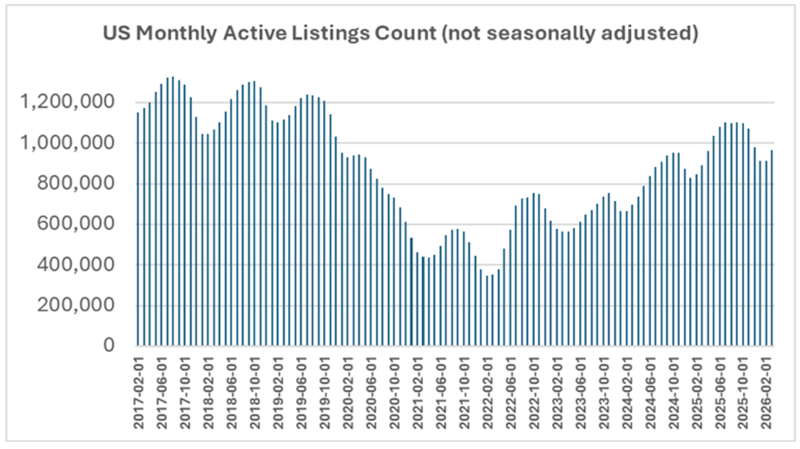
What this means is that first time homebuyers are facing a situation of increasing supply overall since 2023, while repeat or experienced home buyers face a situation where there is likely less total supply than when they last bought pre COVID, even though supply did increase in 2024 and 2025.
Our experience: Our experience in a buyer’s market begins to demonstrate how these larger factors interact with the local conditions. We found that the price of newly-built homes in one local market (Carson City, Nevada) is fairly comparable to the median price of established homes, taking into account similar square footage, location, and maintenance quality. With a large number of new homes coming onto the market and competing well with the established homes (with the exception of smaller lot sizes), there are more choices for the buyer and less of a need to move quickly.
Am I in a Buyer’s Market?
Home Prices Tell the Tale
Price reductions are likely the most obvious variable that a buyer can observe. Typically, if a home can sell in its first few weeks of listing, it will sell for the full listing price. While it’s not perfect data (because of different times of the year), Zillow shared that around 50% of homes sold under list price in September 2024, compared to January 2026 when 60% of homes sold under list price. Additionally, Redfin reports that 34% of home sellers cut their listing price in February 2026, the highest for the month of February since 2012. These two sources suggest a possible buyer’s market.
Homeowners who cannot sell quickly will face pressure to reduce price. Because of this, a home shopper is more likely to experience a buyer’s market by focusing on homes that have been on the market more than 30thirty days. Of course, to employ the strategy of allowing the listing to age, the buyer must be comfortable with losing out on a property that sells quickly.
Our experience: When working with a buyer’s agent recently, she suggested that we not make an offer in the first two weeks of a home being listed that we liked in order to allow that time to pass. That home ultimately sold at 10.6% below the asking price in 131 days (we elected not to bid). We’ve also seen homes in top condition sell within a few days, while most of the inventory that is not in top condition remains on the market well beyond 30thirty days.
Am I in a Buyer’s Market?
Median Days on the Market Factor In
Longer median days on the market (i.e., how long it takes for the house to sell from listing to sale closing) is another potential indicator of a buyer’s market. Between 2023 and 2025, median days on the market for homes in the United States rose steadily from 49 to 62, and the trend has continued in the first quarter this year, according to FRED. So, in the most recent calendar years, the increase in median days also points to a buyer’s market.
‘Immediate Sales’ Are on the Decline
Relatedly, “immediate sales” are decreasing as a segment of the national market. An “Immediate sale” is defined by Mike Simonsen of Altos Research as “homes going under contract in less than one week.”
Since 2021, the proportion of homes that fall into the category of “immediate sales” has been decreasing. One implication of this change is that buyers who are comfortable passing on the most competitive properties that sell the most quickly have more options.
Long-Term Trends Show ‘New Listings’ Decreased 20% Since 2017
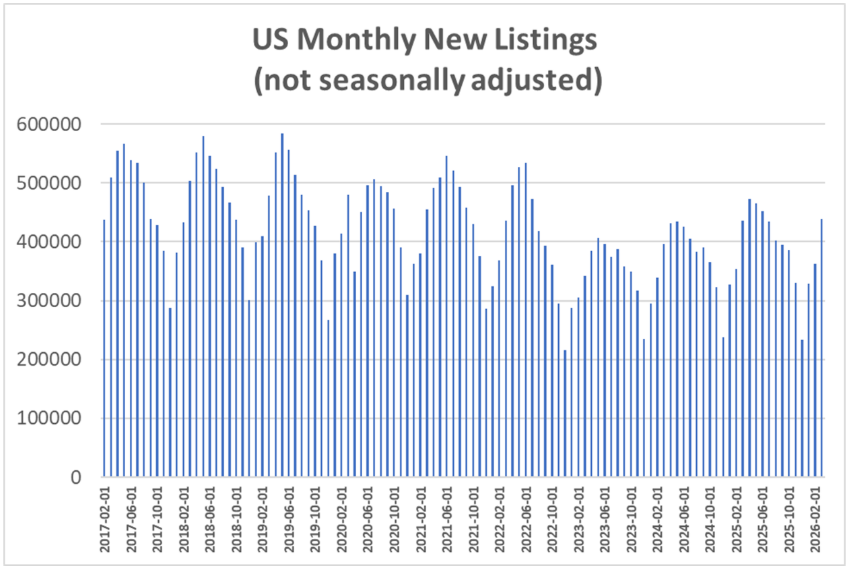
Median days on the market are also reflected in the discrepancy between the pattern of new listings and the pattern of overall supply. Above, we discussed how the overall supply of housing on the market is increasing again after hitting a low in 2021/2022.
However, from FRED, we can see that new listings have trended down overall since 2017. Supply contracted around 20% as measured by monthly new home listings. If supply is increasing while new listings remain down, the increase must be due to older listings remaining on the market for longer: so these two indicators when compared suggest increases in median days on the market.
‘Months of Supply’ Is a Valuable Local Measure
A final measure related to median days on the market for a buyer to investigate is “months of supply.” This measure is calculated by taking the total home inventory and dividing it by the number of homes available. One source for this is the National Association of Realtors, which reported months of supply across the United States at 3.8 in February 2026, up from 3.6 in January 2026.
Looking at a long time horizon from January 2022 through March 2026 shows considerable variation at the national level, with the highest measures of single family home “months of supply” reached in May to August 2025 at 4.6 and the lowest at 1.6 in January 2022.
A buyer will need to hone in on months of supply in their market of interest. Often, this measure is a hidden indicator of a buyer’s market. Ask your agent: What is the level and trend in “months of supply?”
Our experience: When you’re trying to understand how much a market turns over, a local agent may be able to provide a better estimate of the median days and months of supply, which can help you understand the portion of the market that falls into the immediate sales category and how fast in general you need to move. In our experience from homes we’ve tracked locally, immediate sales are just 6% of the listings that meet our buying criteria, so this suggests that the median days are longer and we are in a buyer’s market.
Am I in a Buyer’s Market?
Concessions Are a Key Hidden Sign
Increasing Concessions are another indication of a buyer’s market. Concessions are:
“closing costs or fees that a seller agrees to cover to help reduce a buyer’s upfront expenses…seller concessions can make a home purchase more affordable without lowering the home’s sale price.”
Looking at the data, concessions are popular. 44% of all US home sales included a seller concession in first quarter 2025, similar to first quarter 2023 (also around 45%) and up from 39% in first quarter 2024.
Homebuyers should note, however, that concessions are not the same everywhere. Seattle and Portland saw over 60% of sales with concessions in early 2025. The fact that these major cities had a much higher percentage of concessions than the national average demonstrates considerable regional variation.
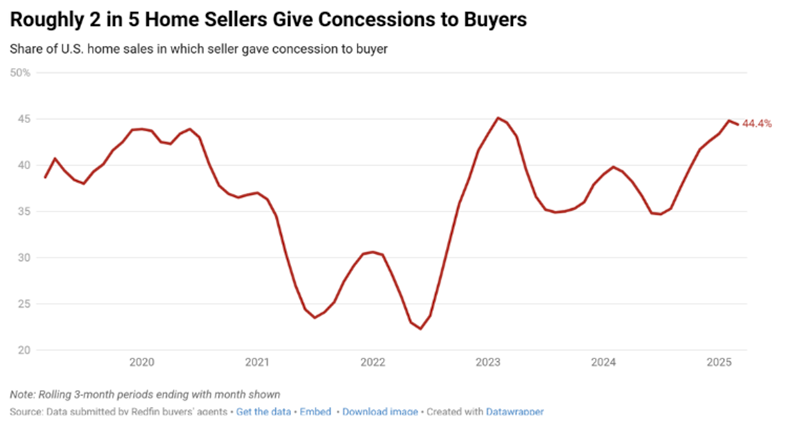
In a given area, it takes knowledge and expertise to discern if concessions are increasing or decreasing. Buyers can ask their agent: are concessions a common practice?
Our experience: We are planning to be on the lookout for concessions when making an offer, and to ask our real estate agent to alert us to these opportunities.
Am I in a Buyer’s Market?
8 Real Estate Markets Ranked
Across the US, there is considerable variation between markets and within markets. As a starting point at the broad metro level, one analysis identified six metro areas that are showing signs of an early buyer’s market:
- Atlanta-Sandy Springs-Roswell, GA,
- Austin-Round Rock, TX,
- Jacksonville, FL,
- Miami-Fort Lauderdale-West Palm Beach, FL,
- Orlando-Kissimmee-Sanford, FL and
- Riverside-San Bernardino-Ontario, CA.
When we consider regional variation, we can also use “months of supply” to see a buyers’ market. Industry sources suggest that six or more “months of supply” are indicative of a buyer’s market. Four markets that are at six months or more of supply are:
- Austin Metro, TX at 6.5 in February 2026
- Fort Myers, FL at 7.9 for homes in February 2026
- Miami-Dade County, FL at 6.2 for homes in February 2026
- Naples, FL at 6.0 for homes in March 2026
It’s interesting to see Austin and Miami appear a second time on this measure as likely buyer’s markets, as they also appeared on the “early buyer’s market” indication.
There are also meaningful differences between condominium months of supply and single family home months of supply, so depending on the buyer’s focus, there may be a more favorable condition, for instance in condominiums. As an example, there are 13.4 months of condominium supply in Miami Date County, FL as of February.
Am I in a Buyer’s Market? Key Summary
Keeping in mind market variations and the differences between visible and hidden signs of a buyers’ market, we can restate and summarize the key aspects of a buyer’s market to keep in mind, below:
| Buyer’s Market | Balanced Market | Seller’s Market | |
| Situation | Excess supply: Supply of homes exceeds the number of active buyers | Balance: Supply and demand are in balance | Excess demand: Demand for homes exceeds the available supply |
| Price Pressure | Downward pricing pressure: Since home prices are sticky down, price reductions may be through concessions | Average | Upward pricing pressure: Homes sell for list price or higher. |
| Inventory: Months of Supply | Higher: 6 or more | 4 to 5.9 | Lower: Under 4 |
| % of Immediate Sales | Lower | Medium | High, e.g., 30% (April 2021) |
| Bidding war | Lower chance of a bidding war | Average | Higher chance of a bidding war |
How a Buyer’s Market Affects Homebuyers
For the average homebuyer, it can be easy to overlook signs of a buyer’s market and miss an opportunity. Whether they are first-time homeowner or a repeat buyer, transactions are infrequent and considerations like the current interest rate climate, monthly payments and household budget are more top-of-mind than market definitions like “buyer’s market” or “seller’s market” .
This confusion presents an opportunity for the buyer who can recognize they are in a buyer’s market and act sufficiently rationally to leverage the buyer’s market situation. In this case, acting rationally requires avoiding the pitfall of falling in love with one property that a homebuyer feels he or she must own and buying it at all costs.
Fundamentally, to activate a buyer’s market buying strategy requires the buyer to be willing to take more time to decide. Fortunately, buyers are taking longer to search according to the National Association of Realtors, with a median time of 10 weeks in 2025. As part of buyer’s search and their conversations with local real estate agents, they can determine if they are in a buyer’s market.
With more time to decide, the buyer gains these main benefits:
- The ability to compare multiple properties. For example, where we are looking, it’s easy to compare multiple new builds as well as existing properties without feeling a lot of time pressure.
- Reduced pressure to waive inspections. While I’ve never experienced pressure to waive an inspection, and would view this as a ‘red flag.’ recognizing that you have other options will make this much easier.
Negotiation power can provide several opportunities, e.g.,
- The buyer can request repairs
- Greater ability to negotiate price
- Contingencies are more likely to be accepted
Risks of Buying in a Buyer’s Market
However, this is not to say all the effects of a buyer’s market are positive. There are also risks for a buyer in this situation to consider:
- Home prices may fall below the level that the buyer purchases at. Supply may continue to outstrip demand for years, resulting in a loss for the home buyer as their home loses value. While falling home prices may be attractive as a buyer, once the buyer becomes a seller this can be problematic.
- Overall economic uncertainty in the specific market. This suggests that the buyer must consider why the buyer’s market is occurring. For instance, are major employers moving out of the region, so that the local economy will be challenged for many years?
| Buyer’s Market Advantages | Buyer’s Market Risks |
| More time to compare properties | Home prices may continue to fall, making the purchase a risky investment |
| Reduced pressure to GIVE concessions | Buyer’s markets may be undesirable places to live and may become more undesirable |
| Increased leverage to GET concessions | |
| More ability to negotiate price |
What Happens to Home Prices in a Buyer’s Market?
Because there are many considerations that drive long-term market demand, it’s not possible to predict the future trend of home prices in a buyer’s market. Local markets will vary significantly, as Austin and Miami Dade trends illustrate.
Looking at the Austin market, for example, the median home sale price fell 18% from its peak in May 2022 to $550,000 in January 2026. Looking at Miami Dade tells a different story, with median prices increasing from 2022 to 2026. Still, condos within Miami Dade have flattened out, with median condominium prices at $415,000 to $420,000 in January 2026, similar to the $415,000 to $425,000 as of June 2024.
Despite the potential buyer’s market outlook for home price declines, price stabilization is more likely. It’s well known that home prices are sticky downward, and few sellers want to sell at a loss. The savvy buyer may focus on keeping the seller whole through concessions or other tactics in order to make the transaction happen.
It’s also important that the buyer recognizes that appreciation is likely to be slow (or even nonexistent) in a buyer’s market and that they can accept this expectation given the high amount of net worth that may be tied up in owning the home.
Motivated sellers in a buyer’s market can be expected to compete more aggressively, with a number of tactics, such as staging the home, making needed repairs, and offering concessions. If these tactics do not work, then they may elect to drop the price.
Insight to Action is a premier market research and business growth consulting firm. Applying our rigorous analysis to the real estate market will help homebuyers answer the question: Am I in a buyer’s market? Check out our blog or subscribe to our newsletter.
